
Skeleton Explorer
- 生物
评论
与此模拟实验相关
按含义从游戏、练习册、模拟实验、教师工具和视频中挑选。

关于这个模拟实验
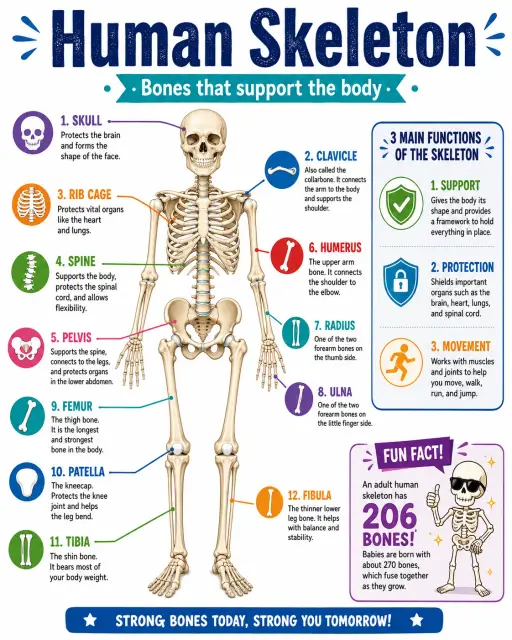
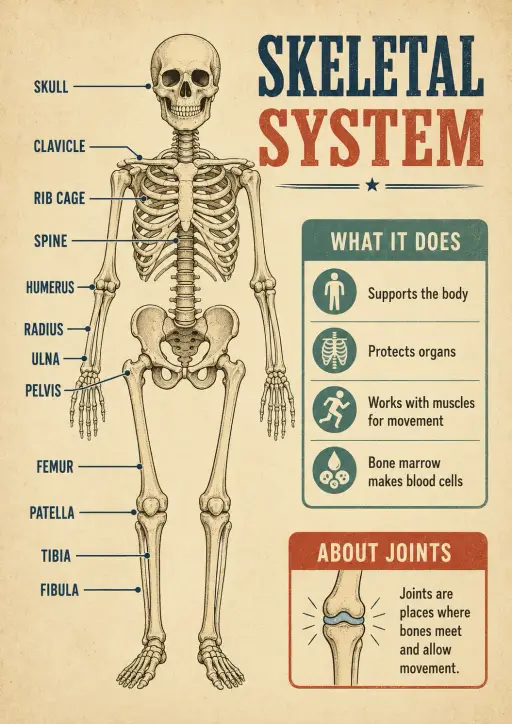
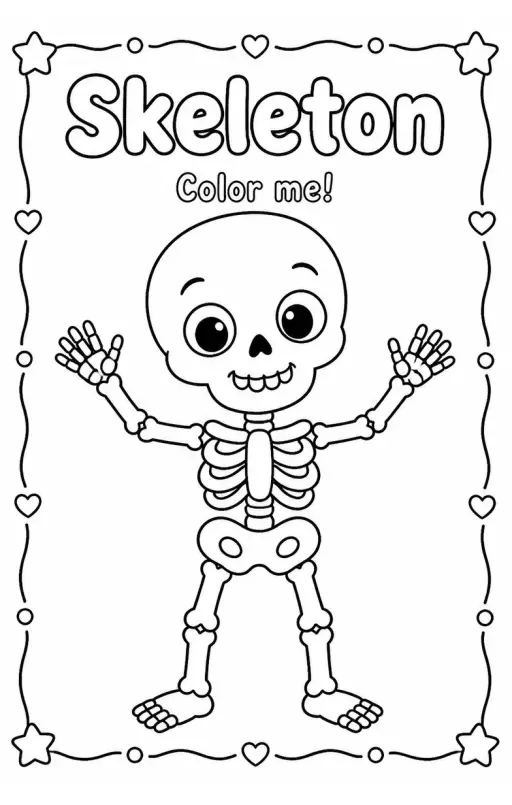
Skeleton Explorer shows a simplified human skeleton in 3D. Students hover over a part to highlight it and click to read its name, a short description and how many bones it represents, while a counter tracks how many parts they have explored. A Pull apart slider separates the groups, Fade bones makes the skeleton see-through, and Quiz mode asks them to find parts, with a Next question button. It teaches that an adult has 206 bones and what the skeleton does, and works well for a lesson on body systems or as a revision game.
学生可以探索什么
- Hover over different parts of the skeleton and click the skull, ribcage and pelvis to read about each.
- Drag the Pull apart slider to separate the bone groups and see how they fit together.
- Switch on Fade bones to see overlapping parts more clearly.
- Turn on Quiz mode, answer a question by clicking the right part, then press Next question.
- Check Parts explored and try to visit every group of bones.
学习目标
- 1Name the main groups of bones in the human skeleton.
- 2State that an adult skeleton has 206 bones.
- 3Describe functions such as support, protection, movement and making blood cells.
- 4Locate bones such as the femur, skull and ribs on a model.
教师常问的问题
Is it free?
Yes. It is free, needs no sign-up and runs in any modern browser, including classroom whiteboards, tablets and phones.
How many bones does an adult have?
An adult has 206 bones. Babies are born with about 270, and some of them fuse together as the child grows.
Are all the bones shown exactly?
No. The bones are simplified shapes and not to scale for fine detail. Hands and feet are drawn as groups that stand for 27 and 26 bones.
How does Quiz mode work?
Switch on Quiz mode, read the question in the Quiz readout, and click the part of the skeleton that answers it. Press Next question when you want a new one.
嵌入这个模拟实验
免费嵌入你的学习平台、博客或班级网站。
<iframe src="https://kiwibee.io/zh-cn/simulations/skeleton-explorer-3d-simulation/embed" title="Skeleton Explorer | KiwiBee" loading="lazy" allowfullscreen style="width:100%;height:min(70vh,620px);min-height:420px;border:0;border-radius:16px"></iframe>课程标准
Cambridge
- 4Bs.01Identify some of the important bones in the human body (limited to skull, jaw, rib cage, hip, spine, leg bones and arm bones)Cambridge Primary Science (0097) — Stage 4 › Biology › Structure and function
- 4Bs.03Describe some of the important functions of skeletons (limited to protecting and supporting organs, enabling movement and giving shape to the body)Cambridge Primary Science (0097) — Stage 4 › Biology › Structure and function
Learning objectives © UCLES (Cambridge University Press & Assessment), quoted with attribution.
把互动科学带进你的课堂
KiwiBee 的免费教师工作台把备课、工作表、课堂工具和成绩册集中在一处。
免费开始,创建你的第一个班级在 YouTube 上观看 KiwiBee
面向教师和学校的 KiwiBee 短视频。订阅频道,或在你常用的平台上关注 KiwiBee。
 首页
 全部解决方案
 价格
 关于我们
 KiwiBee 非营利组织计划
 活动与网络研讨会
 面向大型教育集团
 面向学校
 面向教育中心
 面向团队负责人
 面向教师
 教学资源
 可打印练习单
 互动模拟实验
 教师工具
 灵感与研究


