
Explore an adult male reference body in 3D. Reveal 14 anatomical systems, search thousands of named structures, isolate organs, and pull 2,209 modeled pieces apart to see how the body is organized.
—
KiwiBee वयस्क विज़िटर्स को समझने, पूरे हुए साइन-अप मापने और अभियानों को बेहतर बनाने के लिए Google Analytics, Google Ads और Meta Pixel की वैकल्पिक कुकीज़ का उपयोग करता है। ज़रूरी कुकीज़ हमेशा चालू रहती हैं। OpenAI का ChatGPT Ads Pixel विज्ञापन की सहमति के बाद पेज व्यू और भेजी गई पूछताछ भी मापता है और मिलान के लिए हैश किए गए संपर्क विवरण का उपयोग कर सकता है। गोपनीयता नीति
CRISPR-Cas9 Gene Editing 3D lets students operate the molecular scissors revolutionising modern genetics and biotechnology. A translucent bilobed Cas9 protein carrying a glowing pink 20-nucleotide guide RNA (gRNA) slides along a 3D double-stranded DNA helix. When students drag the Cas9 complex onto the golden 3-base PAM motif (5'-NGG-3'), the target DNA unwinds into an R-loop bubble and the HNH and RuvC nuclease domains make a double-strand break. Students can switch between Uncut, NHEJ Gene Knockout (indel frameshift), and HDR Precise Edit (donor template knock-in) and verify the resulting allele sizes on a 3D agarose gel electrophoresis slab.
PAM stands for Protospacer Adjacent Motif—most commonly 5'-NGG-3' for Streptococcus pyogenes Cas9. Cas9 will not unwind or cut DNA unless it first recognises a PAM right next to the 20-base target, which also prevents bacteria from cutting their own CRISPR locus.
Non-Homologous End Joining (NHEJ) ligates broken DNA ends back together directly but often inserts or deletes a few bases (indels), knocking out the gene. Homology-Directed Repair (HDR) uses a supplied donor DNA template to write in a precise new sequence.
The Cas9 protein stays exactly the same; scientists only synthesise a new 20-nucleotide guide RNA spacer sequence that is complementary to the new target gene next to a 5'-NGG-3' PAM site.
इसे अपने एलएमएस, ब्लॉग या कक्षा की वेबसाइट पर लगाएँ — मुफ़्त।
<iframe src="https://kiwibee.io/hi/simulations/crispr-cas9-gene-editing-3d-3d-simulation/embed" title="CRISPR-Cas9 Gene Editing | KiwiBee" loading="lazy" allowfullscreen style="width:100%;height:min(70vh,620px);min-height:420px;border:0;border-radius:16px"></iframe>खोज जारी रखें
Explore an adult male reference body in 3D. Reveal 14 anatomical systems, search thousands of named structures, isolate organs, and pull 2,209 modeled pieces apart to see how the body is organized.
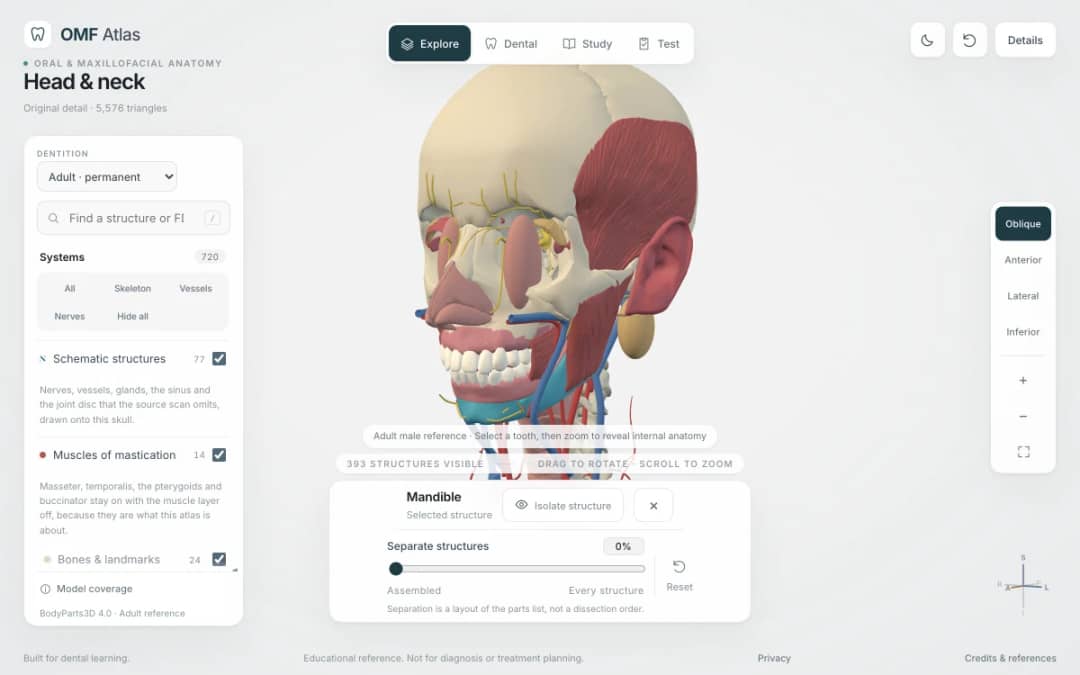
Explore the head and neck in 3D: 643 source meshes across 14 layers, 47 facial and masticatory muscles, and 77 drawn nerves, vessels and glands the source scan omits. Open any tooth onto its own pulp canal, and follow the seven stages of tooth development.

Free interactive photosynthesis simulation. Explore photosynthesis hands-on online — great for whole-class or independent practice.

Free interactive states of matter simulation. Explore states of matter hands-on online — great for whole-class or independent practice.

Free interactive shadows simulation. Explore shadows hands-on online — great for whole-class or independent practice.
KiwiBee का मुफ़्त शिक्षक कार्यक्षेत्र पाठ योजना, वर्कशीट, कक्षा उपकरण और ग्रेडबुक — सब एक ही जगह लाता है।
मुफ़्त शुरू करें और अपनी पहली कक्षा बनाएँ होम
 सभी समाधान
 कीमतें
 हमारे बारे में
 गैर-लाभकारी संस्थाओं के लिए KiwiBee
 कार्यक्रम और वेबिनार
 बड़े संगठनों के लिए
 स्कूलों के लिए
 लर्निंग सेंटरों के लिए
 टीम लीडरों के लिए
 शिक्षकों के लिए
 AI और संसाधन
 संसाधन
 प्रिंट करने योग्य वर्कशीट
 पाठ पैक
 इंटरैक्टिव सिमुलेशन
 शिक्षक उपकरण
 AI स्टूडियो
 विचार और शोध