
Skeleton Explorer
- Biologie
Commentaires
Liées à cette simulation
Choisis selon le sens parmi les jeux, fiches, simulations, outils pour les enseignants et vidéos.
À propos de cette simulation
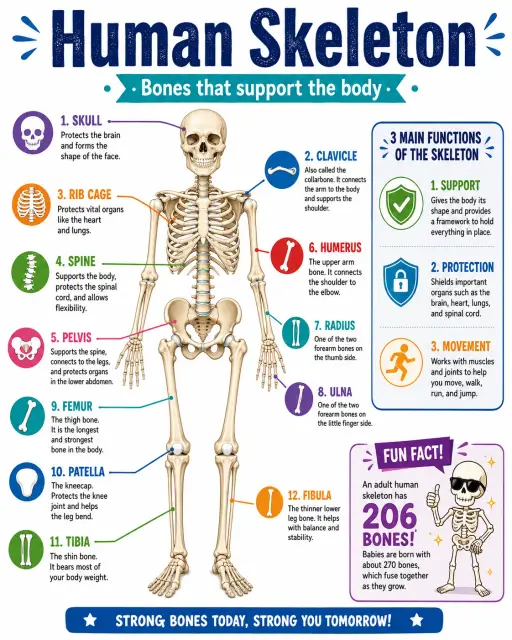
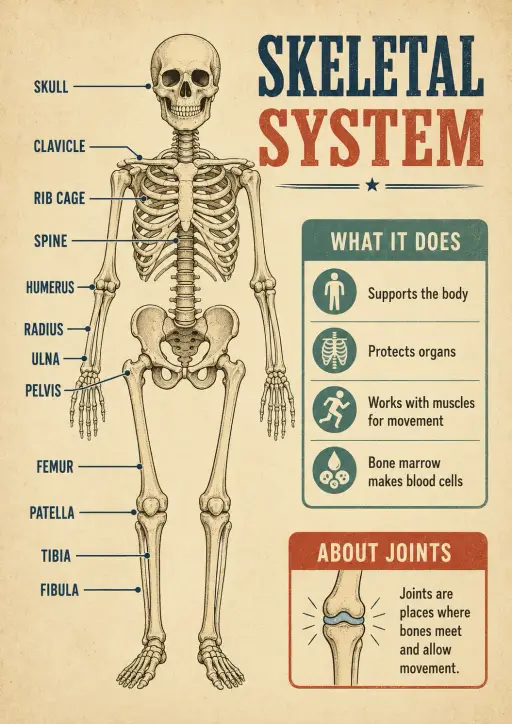
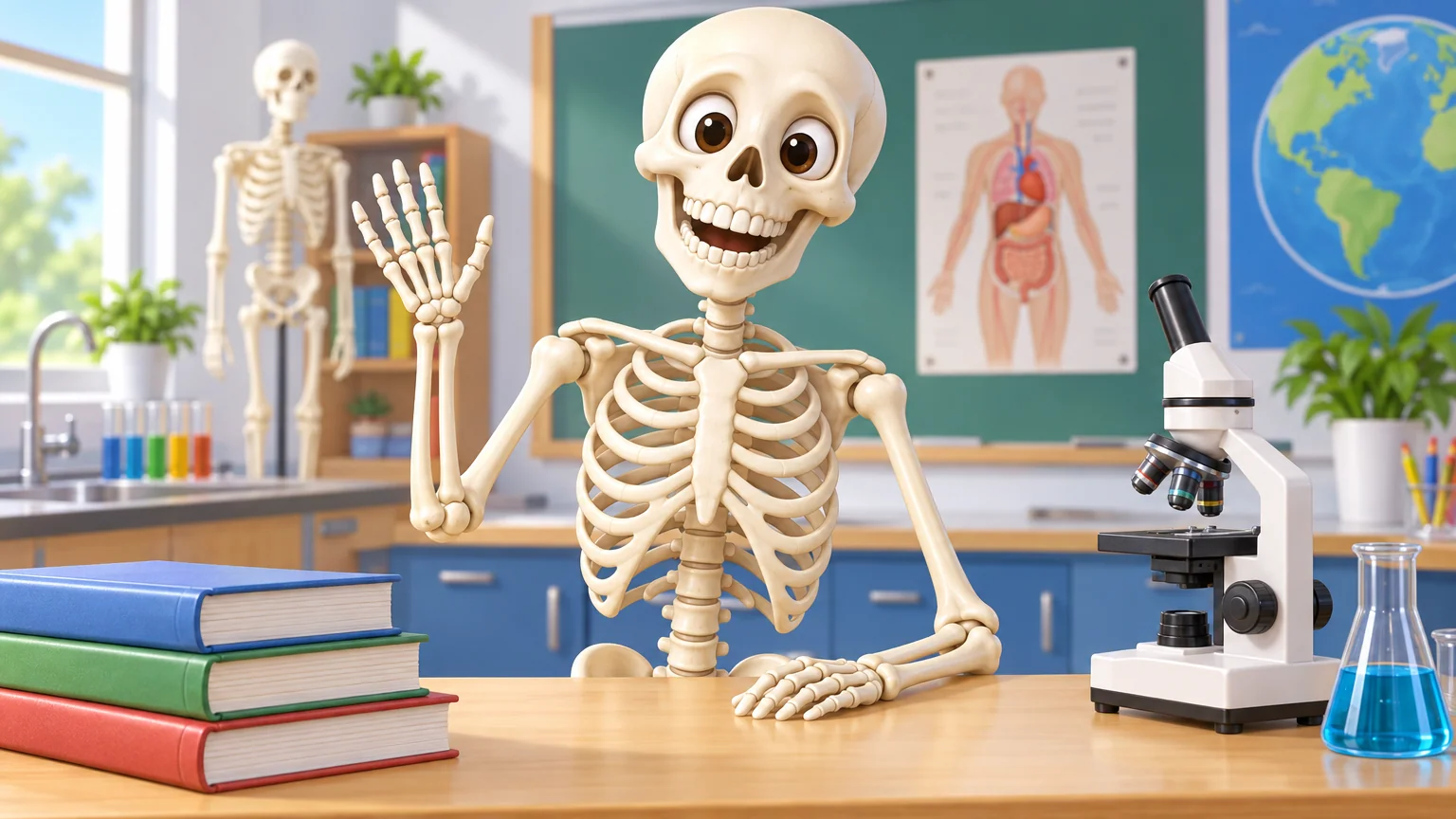
Skeleton Explorer shows a simplified human skeleton in 3D. Students hover over a part to highlight it and click to read its name, a short description and how many bones it represents, while a counter tracks how many parts they have explored. A Pull apart slider separates the groups, Fade bones makes the skeleton see-through, and Quiz mode asks them to find parts, with a Next question button. It teaches that an adult has 206 bones and what the skeleton does, and works well for a lesson on body systems or as a revision game.
Ce que les élèves peuvent explorer
- Hover over different parts of the skeleton and click the skull, ribcage and pelvis to read about each.
- Drag the Pull apart slider to separate the bone groups and see how they fit together.
- Switch on Fade bones to see overlapping parts more clearly.
- Turn on Quiz mode, answer a question by clicking the right part, then press Next question.
- Check Parts explored and try to visit every group of bones.
Objectifs d'apprentissage
- 1Name the main groups of bones in the human skeleton.
- 2State that an adult skeleton has 206 bones.
- 3Describe functions such as support, protection, movement and making blood cells.
- 4Locate bones such as the femur, skull and ribs on a model.
Questions fréquentes des enseignants
Is it free?
Yes. It is free, needs no sign-up and runs in any modern browser, including classroom whiteboards, tablets and phones.
How many bones does an adult have?
An adult has 206 bones. Babies are born with about 270, and some of them fuse together as the child grows.
Are all the bones shown exactly?
No. The bones are simplified shapes and not to scale for fine detail. Hands and feet are drawn as groups that stand for 27 and 26 bones.
How does Quiz mode work?
Switch on Quiz mode, read the question in the Quiz readout, and click the part of the skeleton that answers it. Press Next question when you want a new one.
Intégrer cette simulation
Placez-la dans votre ENT, votre blog ou le site de la classe — gratuitement.
<iframe src="https://kiwibee.io/fr/simulations/skeleton-explorer-3d-simulation/embed" title="Skeleton Explorer | KiwiBee" loading="lazy" allowfullscreen style="width:100%;height:min(70vh,620px);min-height:420px;border:0;border-radius:16px"></iframe>Objectifs du programme
Cambridge
- 4Bs.01Identify some of the important bones in the human body (limited to skull, jaw, rib cage, hip, spine, leg bones and arm bones)Cambridge Primary Science (0097) — Stage 4 › Biology › Structure and function
- 4Bs.03Describe some of the important functions of skeletons (limited to protecting and supporting organs, enabling movement and giving shape to the body)Cambridge Primary Science (0097) — Stage 4 › Biology › Structure and function
Learning objectives © UCLES (Cambridge University Press & Assessment), quoted with attribution.
Faites entrer les sciences interactives dans votre classe
L'espace enseignant gratuit de KiwiBee réunit au même endroit la préparation des séances, les fiches, les outils de classe et le carnet de notes.
Commencez gratuitement et créez votre première classeRegardez KiwiBee sur YouTube
De courtes vidéos KiwiBee pour les enseignants et les écoles. Abonnez-vous, ou suivez KiwiBee où que vous soyez.
 Accueil
 Toutes les solutions
 Tarifs
 À propos
 KiwiBee pour les associations
 Événements et webinaires
 Pour les grands réseaux
 Pour les établissements
 Pour les centres
 Pour les responsables d'équipe
 Pour les enseignants
 Ressources
 Fiches imprimables
 Simulations interactives
 Outils pour les enseignants
 Idées et recherche


