
Explore an adult male reference body in 3D. Reveal 14 anatomical systems, search thousands of named structures, isolate organs, and pull 2,209 modeled pieces apart to see how the body is organized.
—
KiwiBee utilise des cookies facultatifs Google Analytics, Google Ads et Meta Pixel pour comprendre les visiteurs adultes, mesurer les inscriptions finalisées et améliorer ses campagnes. Les cookies essentiels restent toujours actifs. Le pixel publicitaire ChatGPT d’OpenAI mesure aussi les pages vues et les demandes envoyées après consentement publicitaire, et peut utiliser des coordonnées hachées pour la mise en correspondance. Politique de confidentialité
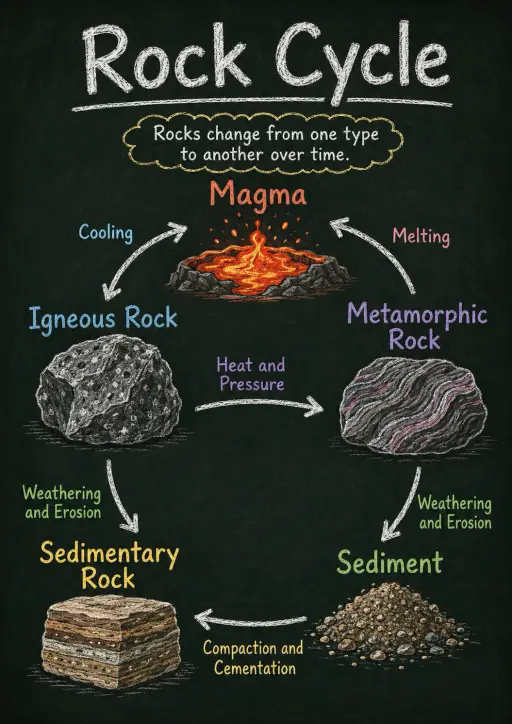
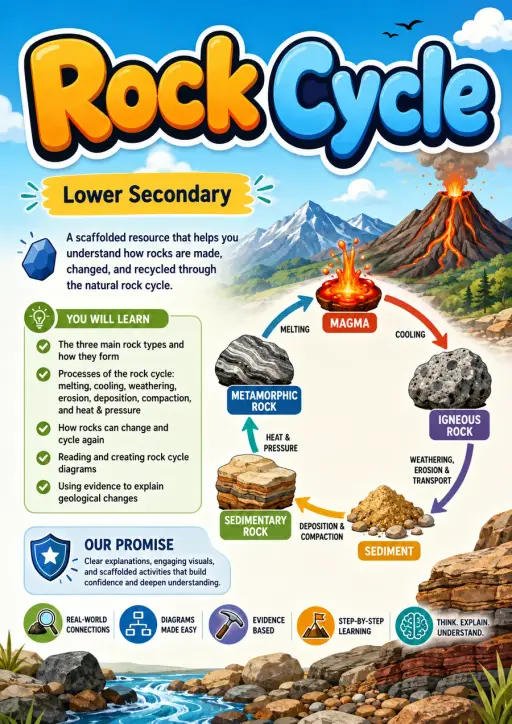
The Rock Cycle 3D Lab links large-scale tectonic and surface processes in Earth's crust to the microscopic mineral textures of rocks. On the left, a 3D geological cross-section features a glowing underground magma pluton, an erupting volcano cone, a layered sedimentary basin, and a deep metamorphic heat-and-pressure zone. On the right, a rotating 3D rock specimen inside a magnifier ring displays procedural mineral textures for coarse intrusive Granite, fine extrusive Basalt, layered clastic Sandstone, and banded foliated Gneiss. Students drag the specimen marker between crust stations or adjust depth and cooling/pressure sliders to see real-time changes in temperature, pressure, and crystal texture.
Granite forms from magma trapped deep underground where surrounding rock insulates it, allowing crystals thousands of years to grow large. Basalt forms from lava extruded onto Earth's surface that chills rapidly before large crystals can form.
Yes. Igneous, sedimentary, or metamorphic rocks uplifted to the surface can weather into sediment to become sedimentary rock, be buried and heated into metamorphic rock, or melt completely into magma to cool into new igneous rock.
Metamorphic rocks recrystallise and align their minerals in the solid state under high heat and directed pressure without melting. Once a rock melts completely into magma or lava, any rock that solidifies from it is classified as igneous.
Placez-la dans votre ENT, votre blog ou le site de la classe — gratuitement.
<iframe src="https://kiwibee.io/fr/simulations/rock-cycle-minerals-3d-3d-simulation/embed" title="The Rock Cycle 3D Lab | KiwiBee" loading="lazy" allowfullscreen style="width:100%;height:min(70vh,620px);min-height:420px;border:0;border-radius:16px"></iframe>Continuer à explorer
Explore an adult male reference body in 3D. Reveal 14 anatomical systems, search thousands of named structures, isolate organs, and pull 2,209 modeled pieces apart to see how the body is organized.

Explore the head and neck in 3D: 643 source meshes across 14 layers, 47 facial and masticatory muscles, and 77 drawn nerves, vessels and glands the source scan omits. Open any tooth onto its own pulp canal, and follow the seven stages of tooth development.

Free interactive photosynthesis simulation. Explore photosynthesis hands-on online — great for whole-class or independent practice.

Free interactive states of matter simulation. Explore states of matter hands-on online — great for whole-class or independent practice.

Free interactive shadows simulation. Explore shadows hands-on online — great for whole-class or independent practice.
Du modèle à la trace écrite
Utilisez une fiche pour recueillir les prédictions, les observations et les explications après l'exploration des élèves.

L'espace enseignant gratuit de KiwiBee réunit au même endroit la préparation des séances, les fiches, les outils de classe et le carnet de notes.
Commencez gratuitement et créez votre première classe Accueil
 Toutes les solutions
 Tarifs
 À propos
 KiwiBee pour les associations
 Événements et webinaires
 Pour les grands réseaux
 Pour les établissements
 Pour les centres
 Pour les responsables d'équipe
 Pour les enseignants
 IA et ressources
 Ressources
 Fiches imprimables
 Kits de cours
 Simulations interactives
 Outils pour les enseignants
 Studio IA
 Idées et recherche