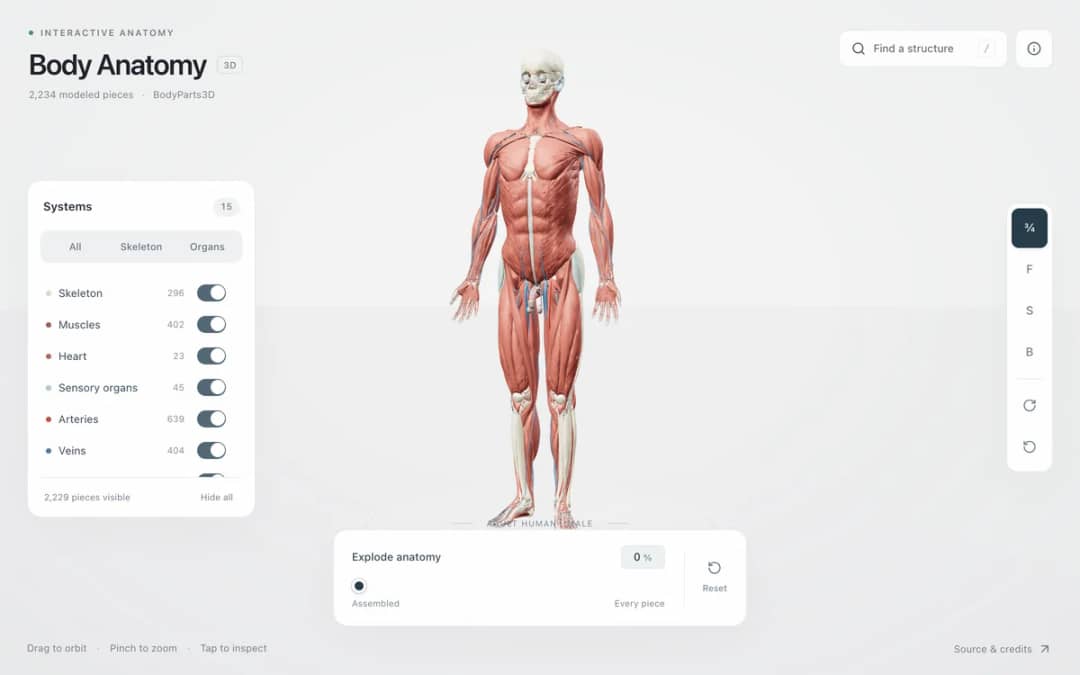
Explore an adult male reference body in 3D. Reveal 14 anatomical systems, search thousands of named structures, isolate organs, and pull 2,209 modeled pieces apart to see how the body is organized.
—
KiwiBee utilise des cookies facultatifs Google Analytics, Google Ads et Meta Pixel pour comprendre les visiteurs adultes, mesurer les inscriptions finalisées et améliorer ses campagnes. Les cookies essentiels restent toujours actifs. Le pixel publicitaire ChatGPT d’OpenAI mesure aussi les pages vues et les demandes envoyées après consentement publicitaire, et peut utiliser des coordonnées hachées pour la mise en correspondance. Politique de confidentialité
CRISPR-Cas9 Gene Editing 3D lets students operate the molecular scissors revolutionising modern genetics and biotechnology. A translucent bilobed Cas9 protein carrying a glowing pink 20-nucleotide guide RNA (gRNA) slides along a 3D double-stranded DNA helix. When students drag the Cas9 complex onto the golden 3-base PAM motif (5'-NGG-3'), the target DNA unwinds into an R-loop bubble and the HNH and RuvC nuclease domains make a double-strand break. Students can switch between Uncut, NHEJ Gene Knockout (indel frameshift), and HDR Precise Edit (donor template knock-in) and verify the resulting allele sizes on a 3D agarose gel electrophoresis slab.
PAM stands for Protospacer Adjacent Motif—most commonly 5'-NGG-3' for Streptococcus pyogenes Cas9. Cas9 will not unwind or cut DNA unless it first recognises a PAM right next to the 20-base target, which also prevents bacteria from cutting their own CRISPR locus.
Non-Homologous End Joining (NHEJ) ligates broken DNA ends back together directly but often inserts or deletes a few bases (indels), knocking out the gene. Homology-Directed Repair (HDR) uses a supplied donor DNA template to write in a precise new sequence.
The Cas9 protein stays exactly the same; scientists only synthesise a new 20-nucleotide guide RNA spacer sequence that is complementary to the new target gene next to a 5'-NGG-3' PAM site.
Placez-la dans votre ENT, votre blog ou le site de la classe — gratuitement.
<iframe src="https://kiwibee.io/fr/simulations/crispr-cas9-gene-editing-3d-3d-simulation/embed" title="CRISPR-Cas9 Gene Editing | KiwiBee" loading="lazy" allowfullscreen style="width:100%;height:min(70vh,620px);min-height:420px;border:0;border-radius:16px"></iframe>Continuer à explorer
Explore an adult male reference body in 3D. Reveal 14 anatomical systems, search thousands of named structures, isolate organs, and pull 2,209 modeled pieces apart to see how the body is organized.
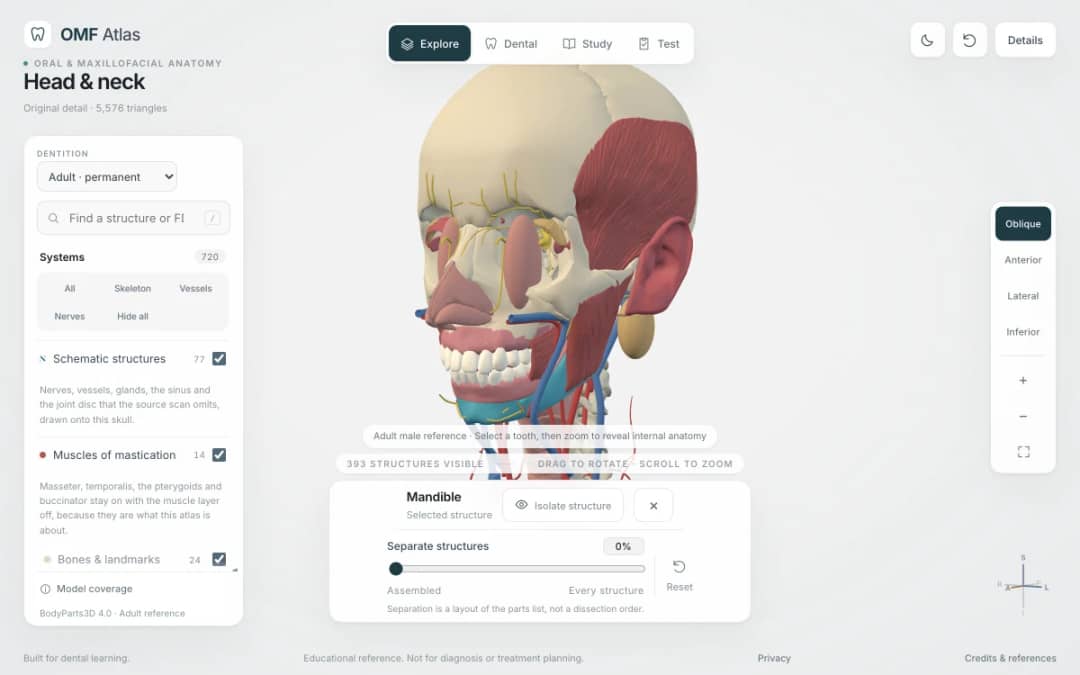
Explore the head and neck in 3D: 643 source meshes across 14 layers, 47 facial and masticatory muscles, and 77 drawn nerves, vessels and glands the source scan omits. Open any tooth onto its own pulp canal, and follow the seven stages of tooth development.

Free interactive photosynthesis simulation. Explore photosynthesis hands-on online — great for whole-class or independent practice.

Free interactive states of matter simulation. Explore states of matter hands-on online — great for whole-class or independent practice.

Free interactive shadows simulation. Explore shadows hands-on online — great for whole-class or independent practice.
L'espace enseignant gratuit de KiwiBee réunit au même endroit la préparation des séances, les fiches, les outils de classe et le carnet de notes.
Commencez gratuitement et créez votre première classe Accueil
 Toutes les solutions
 Tarifs
 À propos
 KiwiBee pour les associations
 Événements et webinaires
 Pour les grands réseaux
 Pour les établissements
 Pour les centres
 Pour les responsables d'équipe
 Pour les enseignants
 IA et ressources
 Ressources
 Fiches imprimables
 Kits de cours
 Simulations interactives
 Outils pour les enseignants
 Studio IA
 Idées et recherche