
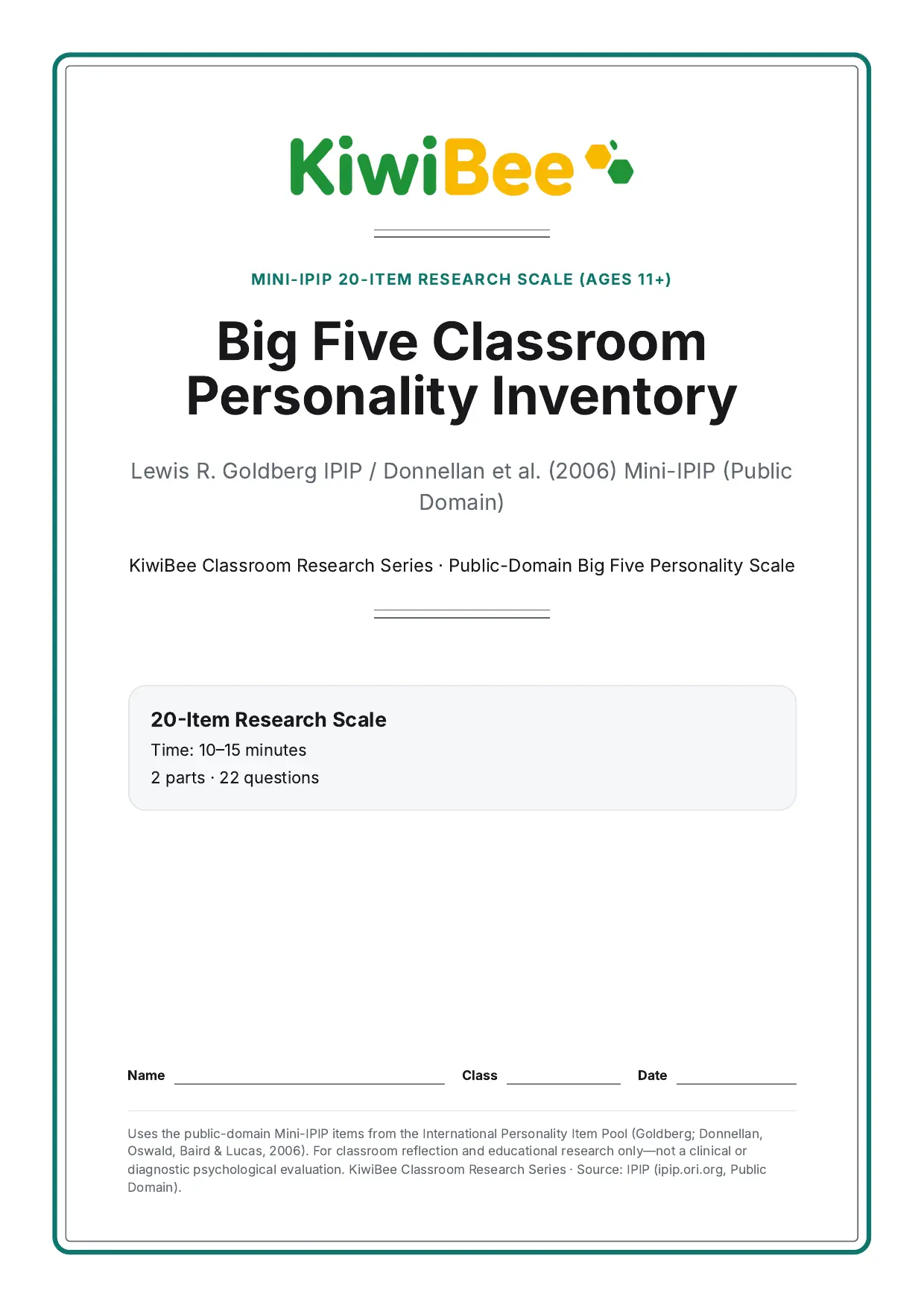
Big Five Classroom Personality Inventory (Mini-IPIP · 20 Items)
Contenu
Chaque sujet avec ses parties, ses questions et sa durée.
20-Item Research Scale
- Parties
- 2
- Questions
- 22
- Durée
- 10–15 minutes
À propos de ce test d'entraînement
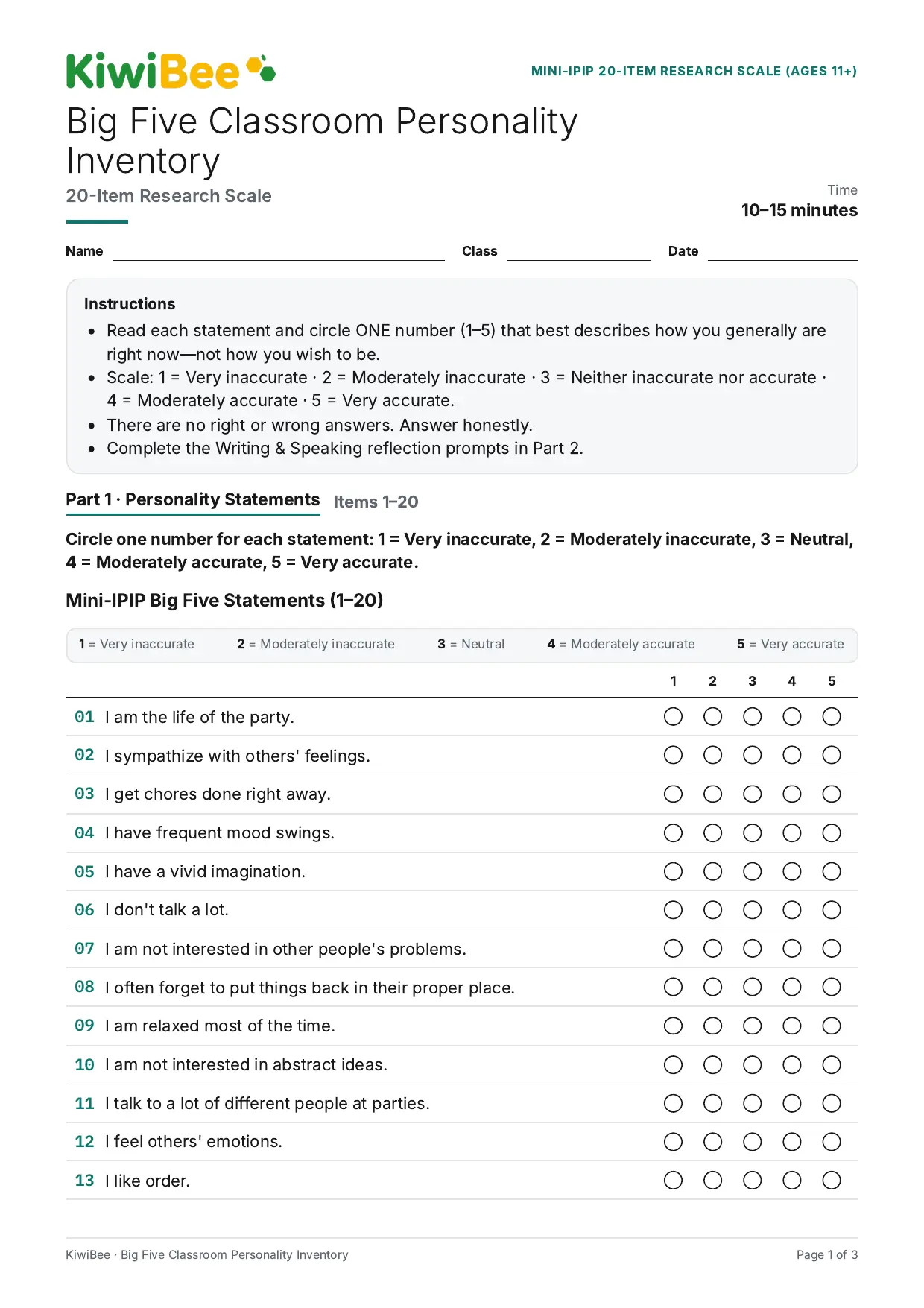
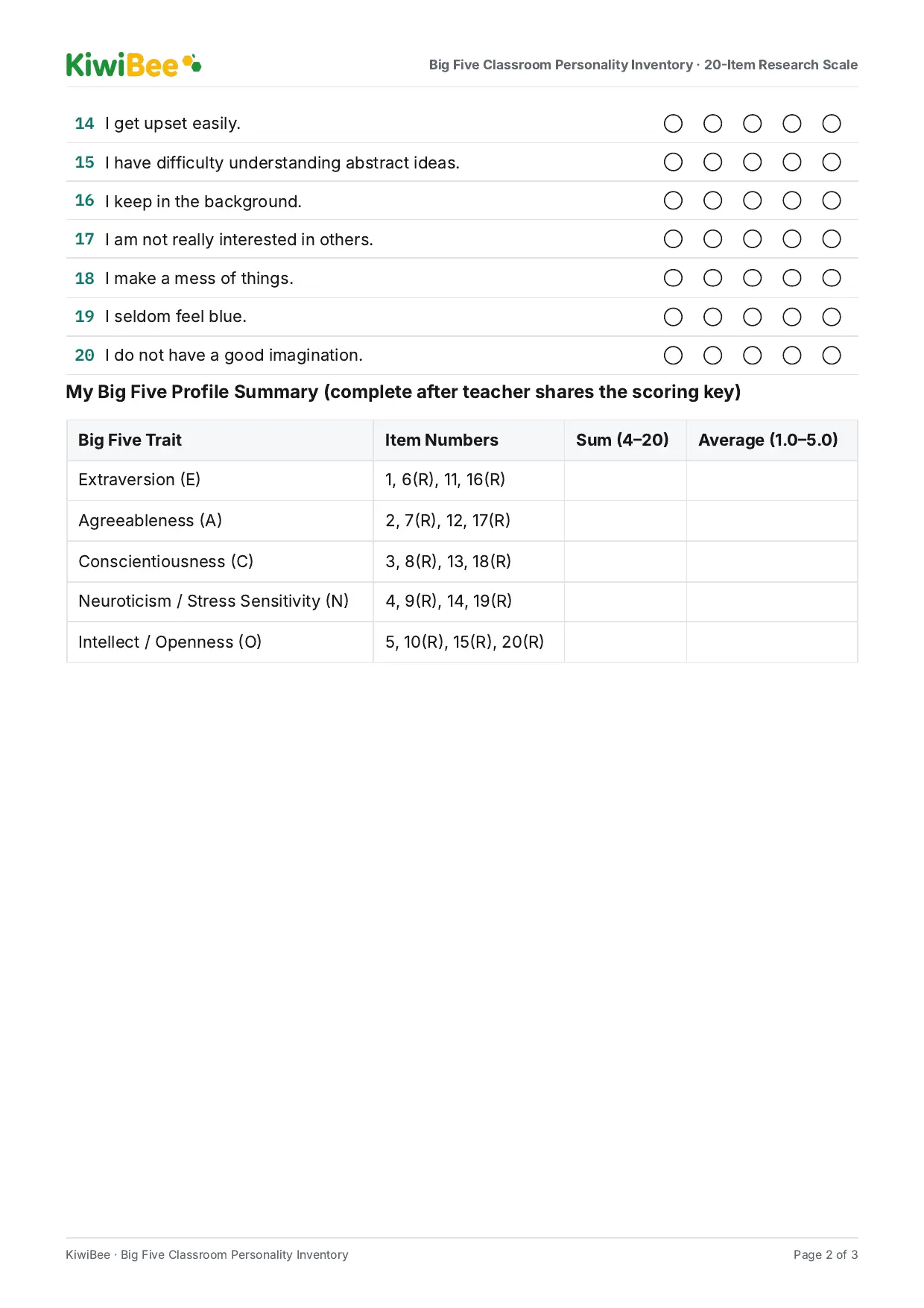
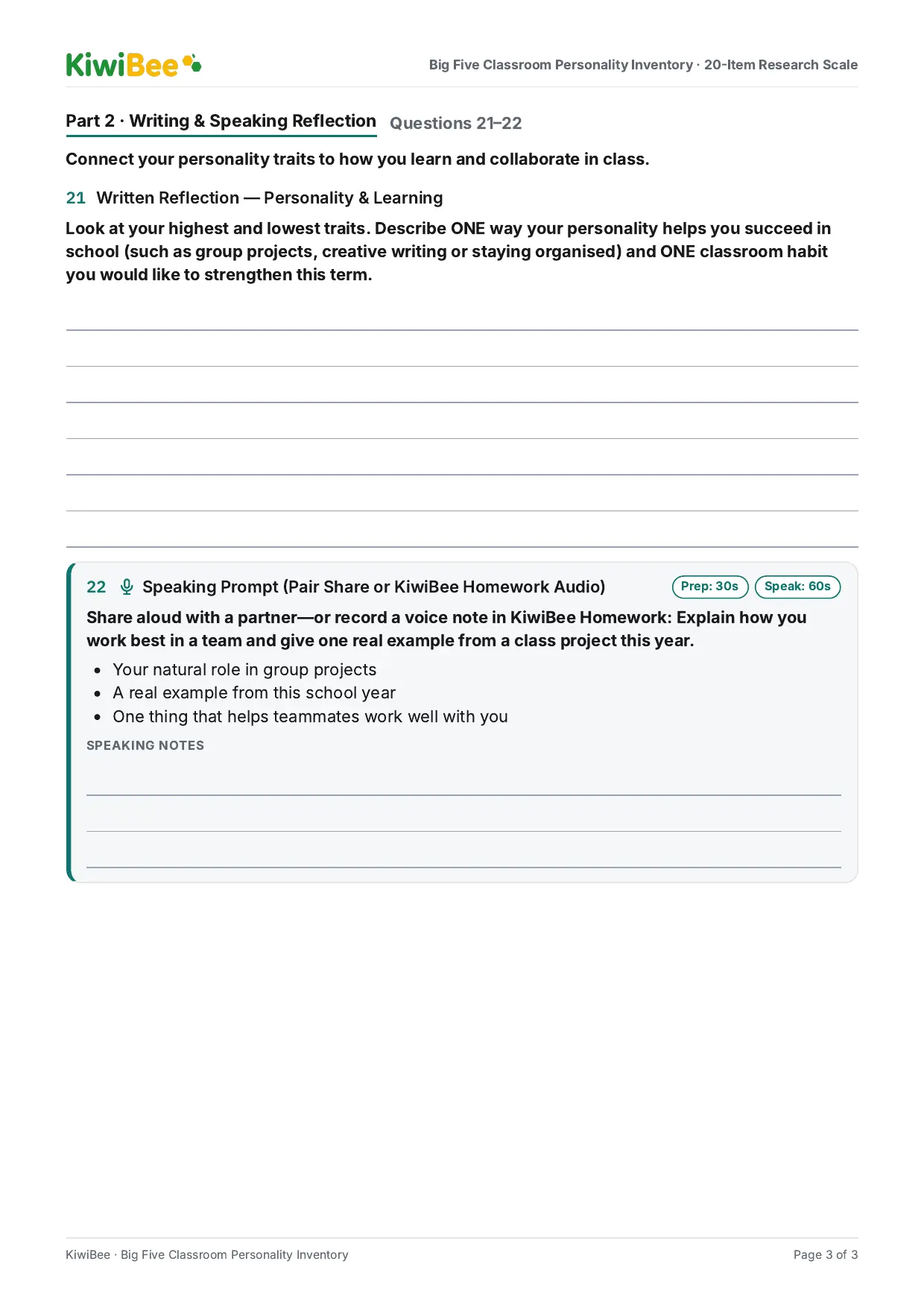
Public-domain Mini-IPIP Big Five (OCEAN) personality test adapted for classroom research and student self-reflection: 20 validated statements measuring Extraversion, Agreeableness, Conscientiousness, Neuroticism and Openness, with a student self-tally sheet, writing and speaking reflection prompts, and a teacher reverse-scoring key.
Questions et réponses
Which psychologist's framework is this test based on?
It uses the public-domain 20-item Mini-IPIP developed by Donnellan, Oswald, Baird, and Lucas (2006) from Lewis R. Goldberg's International Personality Item Pool (IPIP).
How long does the Mini-IPIP take in class?
Most students complete the 20 rating items in 5–8 minutes, plus 5–7 minutes for self-scoring and the writing or speaking reflection.
Why are some items marked (R)?
(R) marks reverse-scored items that reduce response bias. Flip each (R) score with 6 minus the circled number before adding the four items in a trait.
Can teachers use this for formal classroom action research?
Yes. Because the Mini-IPIP is a widely cited public-domain psychometric scale, teachers can legally print, translate, and cite it in classroom studies.
 Accueil
 Toutes les solutions
 Tarifs
 À propos
 KiwiBee pour les associations
 Événements et webinaires
 Pour les grands réseaux
 Pour les établissements
 Pour les centres
 Pour les responsables d'équipe
 Pour les enseignants
 Ressources
 Fiches imprimables
 Simulations interactives
 Outils pour les enseignants
 Idées et recherche


Commentaires