
Skeleton Explorer
- Biología
Comentarios
Relacionado con esta simulación
Elegidos por su significado entre juegos, fichas, simulaciones, herramientas para docentes y vídeos.
Sobre esta simulación
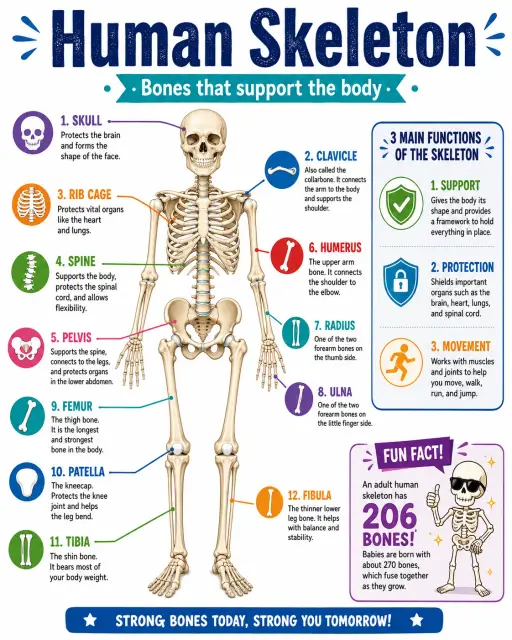
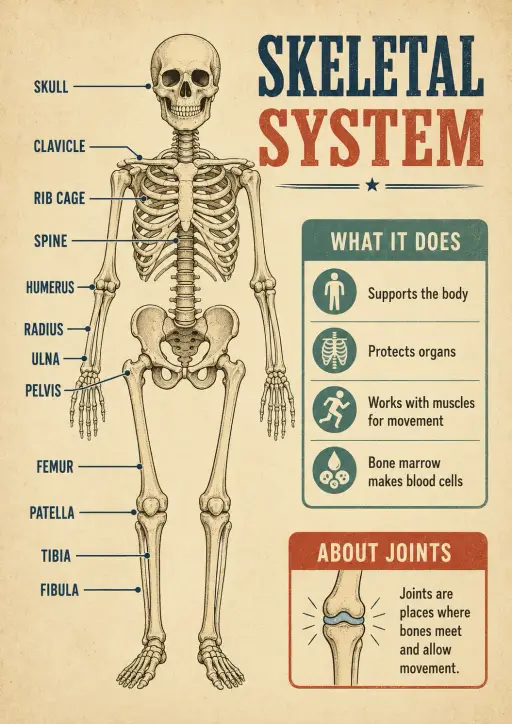
Skeleton Explorer shows a simplified human skeleton in 3D. Students hover over a part to highlight it and click to read its name, a short description and how many bones it represents, while a counter tracks how many parts they have explored. A Pull apart slider separates the groups, Fade bones makes the skeleton see-through, and Quiz mode asks them to find parts, with a Next question button. It teaches that an adult has 206 bones and what the skeleton does, and works well for a lesson on body systems or as a revision game.
Qué pueden explorar los alumnos
- Hover over different parts of the skeleton and click the skull, ribcage and pelvis to read about each.
- Drag the Pull apart slider to separate the bone groups and see how they fit together.
- Switch on Fade bones to see overlapping parts more clearly.
- Turn on Quiz mode, answer a question by clicking the right part, then press Next question.
- Check Parts explored and try to visit every group of bones.
Objetivos de aprendizaje
- 1Name the main groups of bones in the human skeleton.
- 2State that an adult skeleton has 206 bones.
- 3Describe functions such as support, protection, movement and making blood cells.
- 4Locate bones such as the femur, skull and ribs on a model.
Preguntas frecuentes de los docentes
Is it free?
Yes. It is free, needs no sign-up and runs in any modern browser, including classroom whiteboards, tablets and phones.
How many bones does an adult have?
An adult has 206 bones. Babies are born with about 270, and some of them fuse together as the child grows.
Are all the bones shown exactly?
No. The bones are simplified shapes and not to scale for fine detail. Hands and feet are drawn as groups that stand for 27 and 26 bones.
How does Quiz mode work?
Switch on Quiz mode, read the question in the Quiz readout, and click the part of the skeleton that answers it. Press Next question when you want a new one.
Insertar esta simulación
Colócala en tu LMS, blog o sitio de clase, gratis.
<iframe src="https://kiwibee.io/es/simulations/skeleton-explorer-3d-simulation/embed" title="Skeleton Explorer | KiwiBee" loading="lazy" allowfullscreen style="width:100%;height:min(70vh,620px);min-height:420px;border:0;border-radius:16px"></iframe>Estándares curriculares
Cambridge
- 4Bs.01Identify some of the important bones in the human body (limited to skull, jaw, rib cage, hip, spine, leg bones and arm bones)Cambridge Primary Science (0097) — Stage 4 › Biology › Structure and function
- 4Bs.03Describe some of the important functions of skeletons (limited to protecting and supporting organs, enabling movement and giving shape to the body)Cambridge Primary Science (0097) — Stage 4 › Biology › Structure and function
Learning objectives © UCLES (Cambridge University Press & Assessment), quoted with attribution.
Lleva la ciencia interactiva a tu aula
El espacio de trabajo gratuito para docentes de KiwiBee reúne en un solo lugar la planificación de clases, las fichas, las herramientas de aula y el libro de calificaciones.
Empieza gratis y crea tu primera claseMira KiwiBee en YouTube
Vídeos cortos de KiwiBee para docentes y centros. Suscríbete o sigue a KiwiBee donde estés.
 Inicio
 Todas las soluciones
 Precios
 Quiénes somos
 KiwiBee para organizaciones sin fines de lucro
 Eventos y seminarios web
 Para grandes organizaciones
 Para escuelas
 Para centros de aprendizaje
 Para líderes de equipo
 Para docentes
 Recursos
 Hojas de trabajo imprimibles
 Simulaciones interactivas
 Herramientas para docentes
 Ideas e investigación


