Personalizing IEPs for 89 Students Used to Take Me All Summer. Not Anymore.
A SENCO shares how AI helps create truly individualized plans without sacrificing holidays.
 KiwiBee· KiwiBee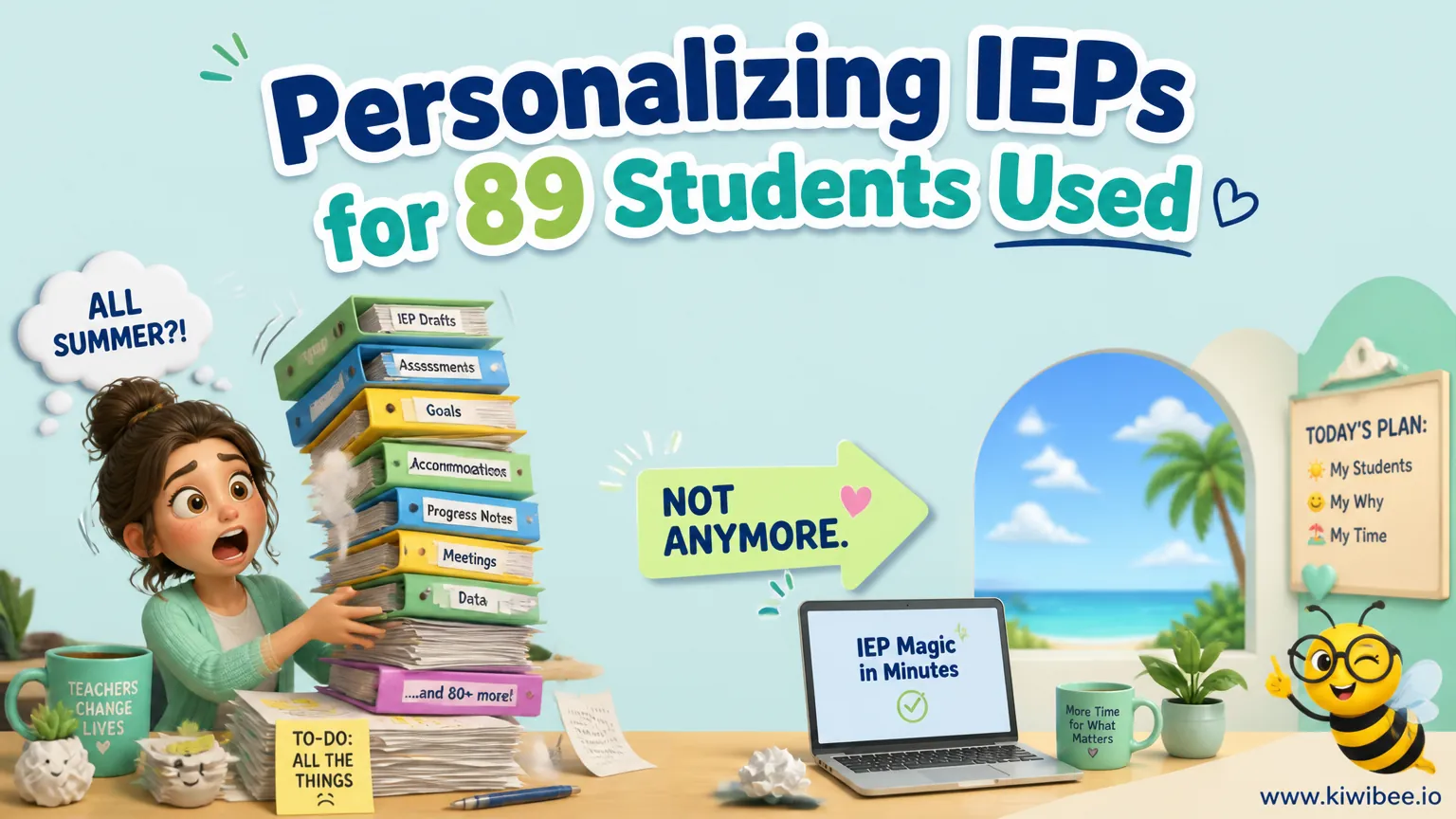
The Impossible Job Description
When I became our school's Special Educational Needs Coordinator, I inherited a caseload of 89 students across all year groups. Each one deserved — and was legally entitled to — an Individualized Education Plan that genuinely reflected their specific needs, goals, and support strategies. The previous SENCO had warned me: 'You'll write IEPs all summer. It's just how it is.'
She was right. That first summer, I spent six weeks at my desk. Each IEP required synthesizing assessment data, teacher input, parent concerns, therapeutic recommendations, and progress monitoring into a coherent document. Even working efficiently, each one took 2-3 hours. The math was brutal: 89 students × 2.5 hours = my entire holiday, plus evenings during term. And I couldn't cut corners — these documents determine the support these children receive.
Finding a Better Way
I discovered KiwiBee's AI-assisted IEP builder at a special needs conference. I was skeptical — IEPs are deeply personal documents that require nuanced understanding of each child. But the demonstration showed something different from what I expected. The AI didn't write IEPs; it helped ME write better IEPs faster.
The system aggregates all the data I was manually hunting for: assessment scores, classroom observations, therapy progress notes, previous goal attainment. It draws from the Student Timeline and suggests evidence-based strategies matched to each student's profile, flagging when proposed accommodations might conflict with each other. But most importantly, it drafts goal language that's specific, measurable, and linked to curriculum standards — the technical writing that used to take me longest.
What's Different Now
This year, my IEP development took two weeks instead of six. Not because the documents are less thorough — they're actually more comprehensive. But the AI handles the data synthesis and technical drafting while I focus on what only a human can do: understanding each child's personality, family context, and what motivates them. I can spend my time in conversations with parents rather than buried in paperwork.
One parent told me, 'This is the first IEP that actually sounds like you know my daughter.' I nearly cried. Because I DO know her daughter — I just finally have time to let that knowledge shine through the documentation. Every child in our care deserves that level of personalization. Now, they can actually have it.
Related posts
How an AI Co-Teacher Personalizes Every Classroom
Discover how Ms. Saunders uses an AI planning assistant to map out weekly lessons, surface intervention groups, and keep families in the loop.
I Used to Spend My Entire December Writing Reports. Now It Takes a Weekend.
After 14 years of teaching, I thought report season exhaustion was just part of the job. Then I discovered what happens when AI knows your students as well as you do.
I Used to Spend Sundays Making Worksheets — AI Changed That Forever
The AI doesn't just create generic worksheets. It looks at each student's gradebook data and generates homework targeting their specific weak spots. Differentiation that would take me hours happens in seconds.