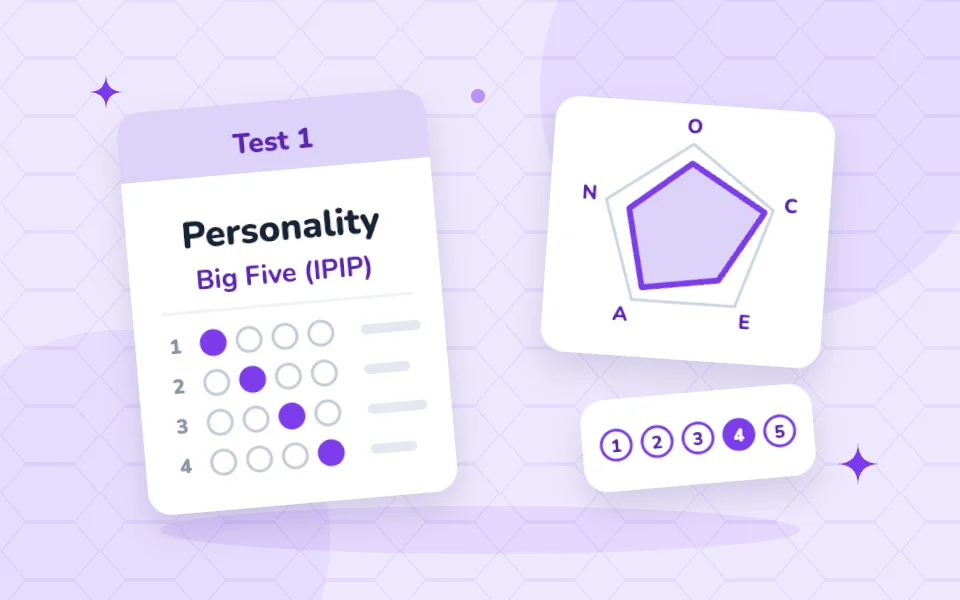
 Big Five Classroom Personality Inventory (Mini-IPIP · 20 Items)PersonalityBig Five (IPIP)
——
KiwiBee 使用 Google Analytics、Google Ads 和 Meta Pixel 的可选 Cookie,用于了解成年访客、统计已完成的注册并改进推广活动。必要 Cookie 始终保持开启。 OpenAI 的 ChatGPT 广告像素还会在您同意广告追踪后衡量页面浏览和已提交的咨询,并可能使用经过哈希处理的联系信息进行匹配。 隐私政策

Public-domain Big Five (OCEAN) classroom personality inventories with clean 1-to-5 Likert rating grids, self-scoring tables, writing & speaking reflection prompts and teacher reverse-scoring keys.
Open any paper to inspect every page and customise it in the KiwiBee Worksheet Print Studio.
KiwiBee's classroom personality inventories draw strictly on public-domain International Personality Item Pool (IPIP) items originated by Lewis Goldberg and the Mini-IPIP short form (Donnellan et al., 2006). They support student self-awareness, balanced group formation and classroom research — not psychological labelling or clinical diagnosis.
Unlike commercial typology quizzes that sort students into fixed boxes, the Big Five measures five continuous, research-backed dimensions that help students reflect on how they work and collaborate.
Curiosity for new ideas, abstract concepts and creative problem-solving — useful when planning inquiry projects and open-ended assignments.
Organisation, follow-through and planning habits — helps teachers pair structure-loving planners with spontaneous brainstormers during team tasks.
Energy in group discussions versus quiet reflection — guides fair classroom participation norms so both outspoken and reflective voices thrive.
Empathy, cooperative warmth and calm under academic pressure — supports social-emotional learning (SEL) and supportive peer feedback routines.
Every paper uses the same KiwiBee Worksheet Print & Edit Studio used across worksheets, exams and olympiads.
Explore KiwiBee's connected assessment libraries for teachers and schools.
The Big Five is the gold standard in peer-reviewed personality psychology, has strong reliability across cultures and ages, and the International Personality Item Pool (IPIP) is explicitly in the public domain — so schools can print, translate and co-brand it legally.
Negatively worded statements (marked R in the teacher key) flip on the 1-to-5 scale (1 becomes 5, 2 becomes 4, 3 stays 3, 4 becomes 2, 5 becomes 1) to reduce acquiescence bias. The teacher answer booklet prints the exact scoring map.
The 20-item Mini-IPIP works best with upper-primary through high-school learners (roughly ages 11 to 18) and takes about 10 minutes to complete plus 10–15 minutes for writing and speaking reflection.
Never. There are no 'good' or 'bad' personality profiles. Keep individual responses private to the student (and teacher/counselor with consent) and only share anonymised class-level summaries during research discussions.
 首页
 全部解决方案
 价格
 关于我们
 KiwiBee 非营利组织计划
 活动与网络研讨会
 面向大型教育集团
 面向学校
 面向教育中心
 面向团队负责人
 面向教师
 教学资源
 可打印练习单
 互动模拟实验
 教师工具
 灵感与研究