Compare a two-body orbit with three-body figure-eight motion, then add up to twelve bodies. Change initial masses, velocities and positions; watch orbit trails and numerical energy error.
—
KiwiBee sử dụng cookie tùy chọn của Google Analytics, Google Ads và Meta Pixel để hiểu khách truy cập là người lớn, đo lường số lượt đăng ký hoàn tất và cải thiện các chiến dịch. Cookie thiết yếu luôn được bật. Pixel quảng cáo ChatGPT của OpenAI cũng đo lượt xem trang và yêu cầu đã gửi sau khi bạn đồng ý quảng cáo, và có thể dùng thông tin liên hệ đã băm để đối sánh. Chính sách quyền riêng tư
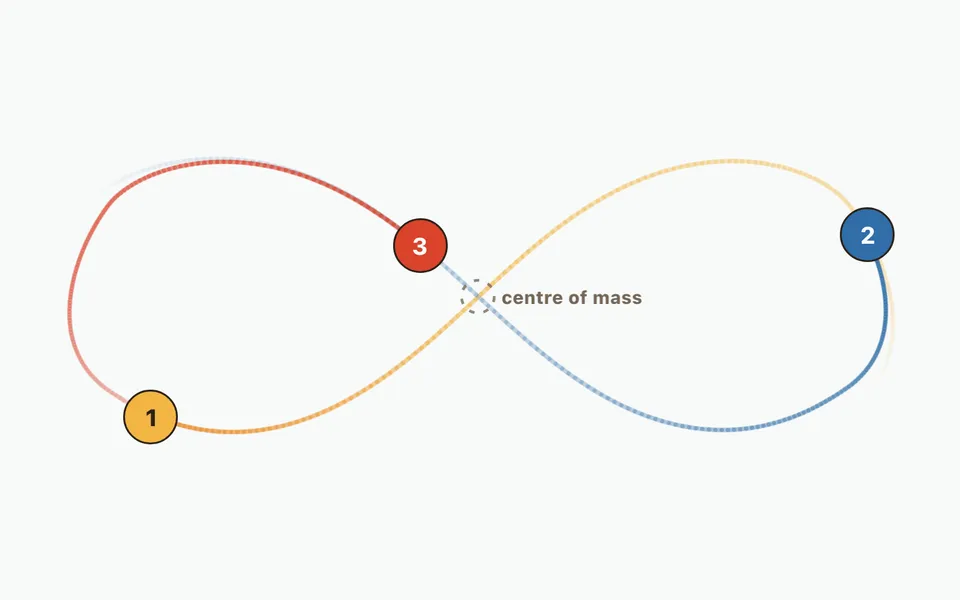
Three-Body Problem is a hands-on 3D simulation of three masses attracting each other with gravity. Students drag any star to a new position, drag the diamond on its arrow to change its velocity, and change each star's mass. Six starting setups are included: the figure-eight orbit, the Lagrange triangle, the butterfly, the Pythagorean 3-4-5 problem, a binary star with a planet and a random start. Readouts show total energy, energy drift, angular momentum and the closest pair, and a twin run shows how a tiny change in the start grows into a completely different future.
Yes. It runs in any modern browser, including interactive whiteboards, tablets and phones, with no sign-up or download.
It asks how three masses move when each pulls on the others with gravity. Two bodies follow neat ellipses, but with three there is no general formula for the future. A few special starting setups repeat exactly, and most others are chaotic.
Three equal masses can chase each other around a single figure-eight shaped path. Cristopher Moore found it numerically in 1993, and Chenciner and Montgomery proved it exists in 2000. In this simulation one lap takes about 6.33 time units.
Drag a star to move it. Drag the small diamond at the end of its arrow to set its speed and direction. Pause first if you want time to set things up, then press Play.
The twin starts one millionth of a unit away from the first star. In a chaotic setup that small gap grows quickly, so the two runs soon look different. In the stable figure-eight the gap stays tiny for a long time.
Đặt vào hệ thống học tập, blog hoặc trang lớp của bạn — miễn phí.
<iframe src="https://kiwibee.io/vn/simulations/three-body-problem-3d-simulation/embed" title="Three-Body Problem | KiwiBee" loading="lazy" allowfullscreen style="width:100%;height:min(70vh,620px);min-height:420px;border:0;border-radius:16px"></iframe>Tiếp tục khám phá
Compare a two-body orbit with three-body figure-eight motion, then add up to twelve bodies. Change initial masses, velocities and positions; watch orbit trails and numerical energy error.

Explore an adult male reference body in 3D. Reveal 14 anatomical systems, search thousands of named structures, isolate organs, and pull 2,209 modeled pieces apart to see how the body is organized.
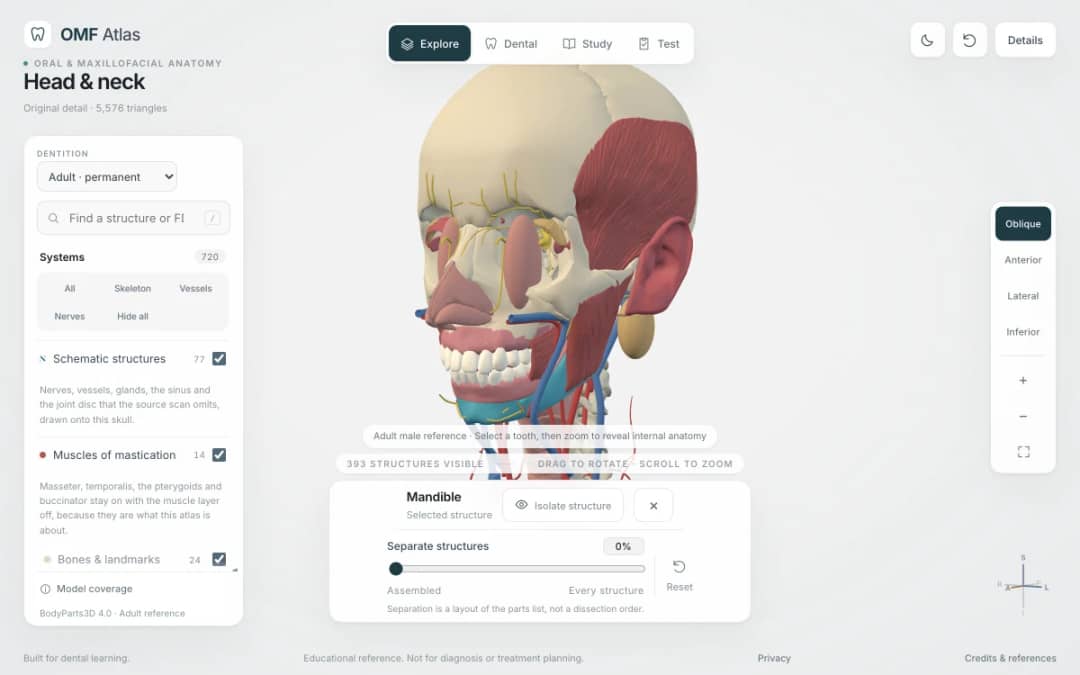
Explore the head and neck in 3D: 643 source meshes across 14 layers, 47 facial and masticatory muscles, and 77 drawn nerves, vessels and glands the source scan omits. Open any tooth onto its own pulp canal, and follow the seven stages of tooth development.

Free interactive photosynthesis simulation. Explore photosynthesis hands-on online — great for whole-class or independent practice.

Free interactive states of matter simulation. Explore states of matter hands-on online — great for whole-class or independent practice.
Không gian giáo viên miễn phí của KiwiBee gộp soạn bài, phiếu bài tập, công cụ lớp học và sổ điểm vào cùng một nơi.
Bắt đầu miễn phí và tạo lớp học đầu tiên Trang chủ
 Tất cả giải pháp
 Bảng giá
 Về chúng tôi
 KiwiBee cho tổ chức phi lợi nhuận
 Sự kiện & webinar
 Dành cho tổ chức lớn
 Dành cho trường học
 Dành cho trung tâm
 Dành cho trưởng nhóm
 Dành cho giáo viên
 AI và học liệu
 Học liệu
 Worksheet in được
 Gói bài học
 Mô phỏng tương tác
 Công cụ giáo viên
 Studio AI
 Ý tưởng và nghiên cứu