
Gradient & Tangent Plane 3D
- ریاضی
تبصرے
اس سمیولیشن سے متعلق
کھیلوں، ورک شیٹس، سمیولیشنز، اساتذہ کے اوزار اور ویڈیوز میں سے معنی کی بنیاد پر منتخب۔
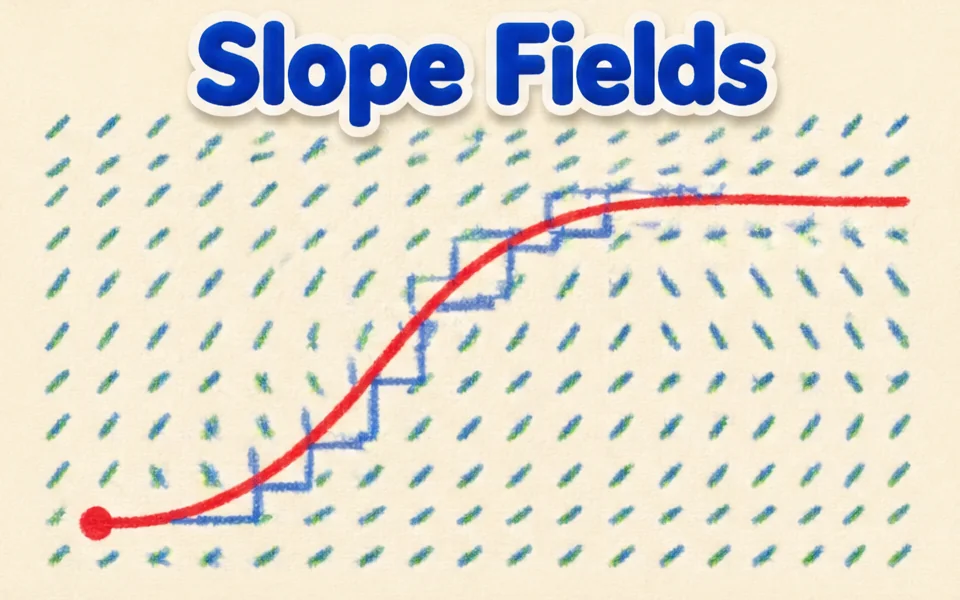
اس سمیولیشن کے بارے میں
Gradient & Tangent Plane 3D brings the core geometry of multivariable differential calculus to life. As students drag the glowing probe sphere across the 3D terrain z = f(x, y), the simulation updates the translucent tangent plane and projects the gradient vector ∇f = ⟨∂f/∂x, ∂f/∂y⟩ onto the topographic contour map below. Red and green tangent arrows show the partial slopes along the x and y axes, while a rotatable cyan arrow shows the directional derivative D_u f = ∇f · û at any chosen angle θ. Clicking the probe releases a gradient-descent ball that rolls downhill along −∇f, tracing how optimization algorithms find local minima.
طلبہ کیا دریافت کر سکتے ہیں
- Drag the red probe sphere around the mountain peak and verify that the tangent plane becomes completely horizontal at the summit where ∇f = ⟨0, 0⟩.
- Rotate the Direction angle θ slider from 0° to 360° and find the angle where the Directional derivative D_u f equals the full Gradient magnitude ‖∇f‖.
- Switch to the Top Contour Map camera view and observe that the gold gradient arrow ∇f always points perpendicular to the level contour rings.
- Click Drop descent ball or click the probe sphere in the scene to release the green ball and watch it roll downhill along −∇f.
- Increase Surface steepness and observe how the tangent plane tilt and gradient arrow length scale proportionally.
تدریسی مقاصد
- 1Calculate and visualize partial derivatives ∂f/∂x and ∂f/∂y as slopes of traces parallel to the coordinate axes.
- 2Explain why the gradient vector ∇f points in the direction of steepest ascent and is orthogonal to contour lines.
- 3Relate the directional derivative D_u f = ∇f · û to the angle between the direction vector û and the gradient ∇f.
- 4Describe how the tangent plane provides a local linear approximation to a differentiable surface z = f(x, y).
اساتذہ کے عام سوالات
What does the gradient vector ∇f represent geometrically?
The gradient ∇f = ⟨∂f/∂x, ∂f/∂y⟩ is a 2D vector in the domain plane whose direction points toward the steepest uphill climb on the surface z = f(x, y), and whose length ‖∇f‖ equals that maximum slope.
Why is the gradient always perpendicular to contour lines?
Along any contour curve, the surface height z = f(x, y) is constant, so the directional derivative tangent to the contour is zero. Because D_u f = ∇f · û = 0 along the contour tangent, the gradient vector ∇f must be perpendicular to the contour.
How is the directional derivative related to the partial derivatives?
For a unit direction vector û = ⟨cos θ, sin θ⟩, the directional derivative is the dot product D_u f = (∂f/∂x) cos θ + (∂f/∂y) sin θ, blending both partial slopes.
What is gradient descent and how is it shown here?
Gradient descent is an optimization algorithm that takes steps in the direction of −∇f (steepest descent) to minimize a function. In this simulation, the green ball follows −∇f downhill until it reaches a local valley.
یہ سمیولیشن اپنی سائٹ میں شامل کریں
اسے اپنے ایل ایم ایس، بلاگ یا کلاس کی ویب سائٹ پر لگائیں — مفت۔
<iframe src="https://kiwibee.io/ur/simulations/gradient-directional-derivative-3d-3d-simulation/embed" title="Gradient & Tangent Plane 3D | KiwiBee" loading="lazy" allowfullscreen style="width:100%;height:min(70vh,620px);min-height:420px;border:0;border-radius:16px"></iframe>تعاملی سائنس اپنے کلاس روم میں لائیں
KiwiBee کا مفت اساتذہ ورک اسپیس سبق کی منصوبہ بندی، ورک شیٹس، کلاس روم اوزار اور گریڈ بک کو ایک ہی جگہ لے آتا ہے۔
مفت شروع کریں اور اپنی پہلی کلاس بنائیںYouTube پر KiwiBee دیکھیں
اساتذہ اور اسکولوں کے لیے KiwiBee کی مختصر ویڈیوز۔ سبسکرائب کریں، یا جہاں بھی ہوں KiwiBee کو فالو کریں۔
 ہوم
 تمام حل
 قیمتیں
 ہمارے بارے میں
 غیر منافع بخش اداروں کے لیے KiwiBee
 تقریبات اور ویبینارز
 بڑے اداروں کے لیے
 اسکولوں کے لیے
 تعلیمی مراکز کے لیے
 ٹیم لیڈرز کے لیے
 اساتذہ کے لیے
 وسائل
 قابلِ طباعت ورک شیٹس
 تعاملی سمیولیشنز
 اساتذہ کے اوزار
 خیالات اور تحقیق


