
Skeleton Explorer
- Biologia
Comentários
Relacionados a esta simulação
Escolhidos pelo significado entre jogos, atividades, simulações, ferramentas para professores e vídeos.
Sobre esta simulação
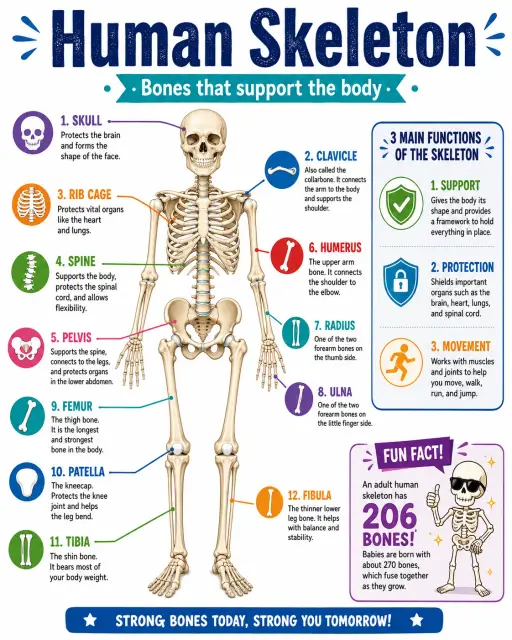
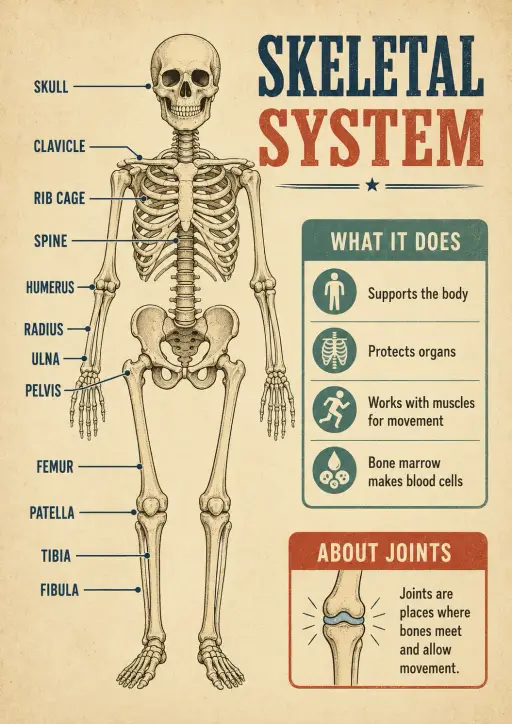
Skeleton Explorer shows a simplified human skeleton in 3D. Students hover over a part to highlight it and click to read its name, a short description and how many bones it represents, while a counter tracks how many parts they have explored. A Pull apart slider separates the groups, Fade bones makes the skeleton see-through, and Quiz mode asks them to find parts, with a Next question button. It teaches that an adult has 206 bones and what the skeleton does, and works well for a lesson on body systems or as a revision game.
O que os alunos podem explorar
- Hover over different parts of the skeleton and click the skull, ribcage and pelvis to read about each.
- Drag the Pull apart slider to separate the bone groups and see how they fit together.
- Switch on Fade bones to see overlapping parts more clearly.
- Turn on Quiz mode, answer a question by clicking the right part, then press Next question.
- Check Parts explored and try to visit every group of bones.
Objetivos de aprendizagem
- 1Name the main groups of bones in the human skeleton.
- 2State that an adult skeleton has 206 bones.
- 3Describe functions such as support, protection, movement and making blood cells.
- 4Locate bones such as the femur, skull and ribs on a model.
Perguntas frequentes dos professores
Is it free?
Yes. It is free, needs no sign-up and runs in any modern browser, including classroom whiteboards, tablets and phones.
How many bones does an adult have?
An adult has 206 bones. Babies are born with about 270, and some of them fuse together as the child grows.
Are all the bones shown exactly?
No. The bones are simplified shapes and not to scale for fine detail. Hands and feet are drawn as groups that stand for 27 and 26 bones.
How does Quiz mode work?
Switch on Quiz mode, read the question in the Quiz readout, and click the part of the skeleton that answers it. Press Next question when you want a new one.
Incorporar esta simulação
Coloque no seu AVA, blog ou site da turma — de graça.
<iframe src="https://kiwibee.io/pt/simulations/skeleton-explorer-3d-simulation/embed" title="Skeleton Explorer | KiwiBee" loading="lazy" allowfullscreen style="width:100%;height:min(70vh,620px);min-height:420px;border:0;border-radius:16px"></iframe>Padrões curriculares
Cambridge
- 4Bs.01Identify some of the important bones in the human body (limited to skull, jaw, rib cage, hip, spine, leg bones and arm bones)Cambridge Primary Science (0097) — Stage 4 › Biology › Structure and function
- 4Bs.03Describe some of the important functions of skeletons (limited to protecting and supporting organs, enabling movement and giving shape to the body)Cambridge Primary Science (0097) — Stage 4 › Biology › Structure and function
Learning objectives © UCLES (Cambridge University Press & Assessment), quoted with attribution.
Leve a ciência interativa para a sua sala de aula
O espaço gratuito do professor da KiwiBee reúne em um só lugar o planejamento de aulas, as atividades, as ferramentas de sala e o diário de classe.
Comece grátis e crie sua primeira turmaAssista ao KiwiBee no YouTube
Vídeos curtos do KiwiBee para professores e escolas. Inscreva-se ou siga o KiwiBee onde você estiver.
 Início
 Todas as soluções
 Preços
 Sobre nós
 KiwiBee para organizações sem fins lucrativos
 Eventos e webinars
 Para grandes redes de ensino
 Para escolas
 Para centros educacionais
 Para líderes de equipe
 Para professores
 Recursos
 Atividades para imprimir
 Simulações interativas
 Ferramentas para professores
 Ideias e pesquisa


