
Circuit Builder
- Física
Comentários
Relacionados a esta simulação
Escolhidos pelo significado entre jogos, atividades, simulações, ferramentas para professores e vídeos.
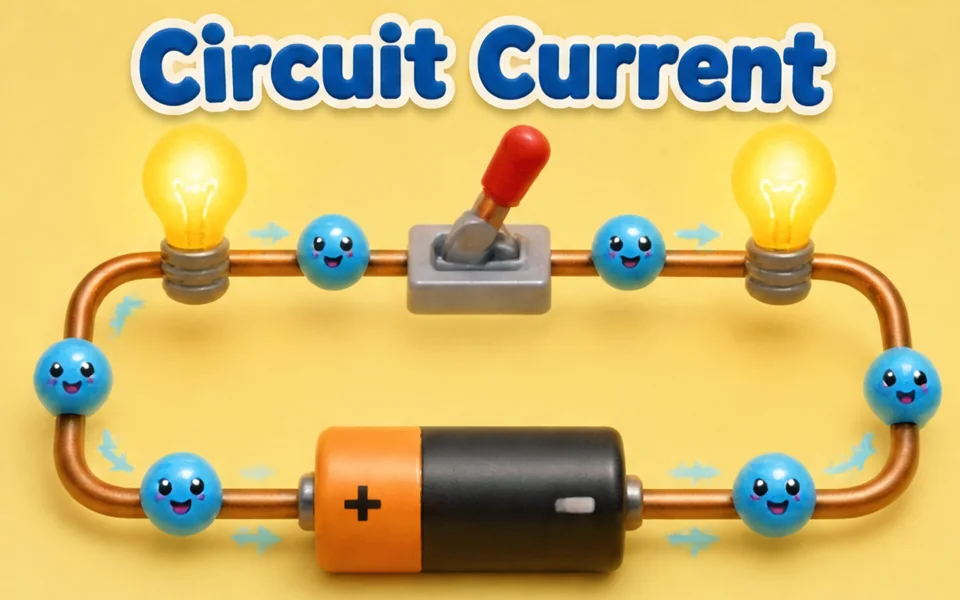 SimulaçãoFluxo de Corrente em Circuito
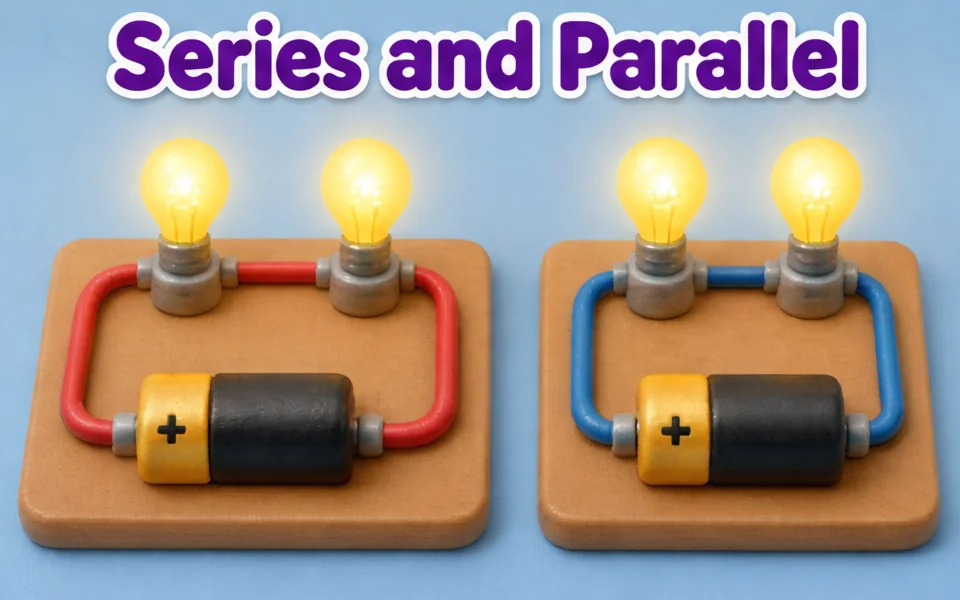 SimulaçãoSimulação interativa de Circuitos em série e em paralelo
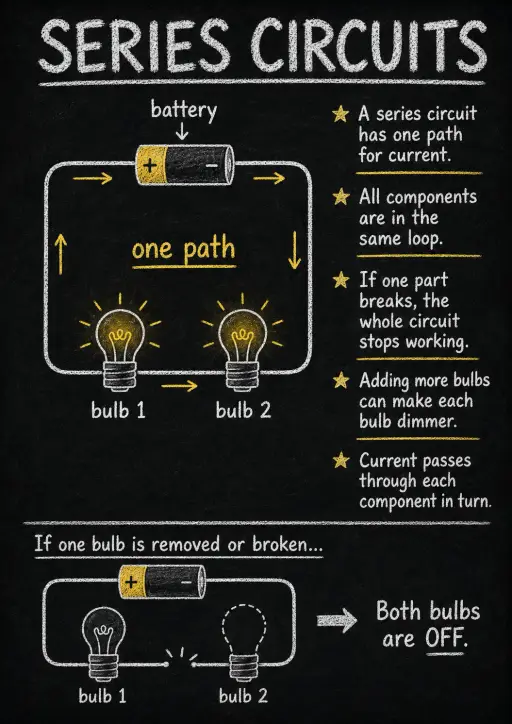 AtividadeSeries circuits Electricity and Magnetism Infographic
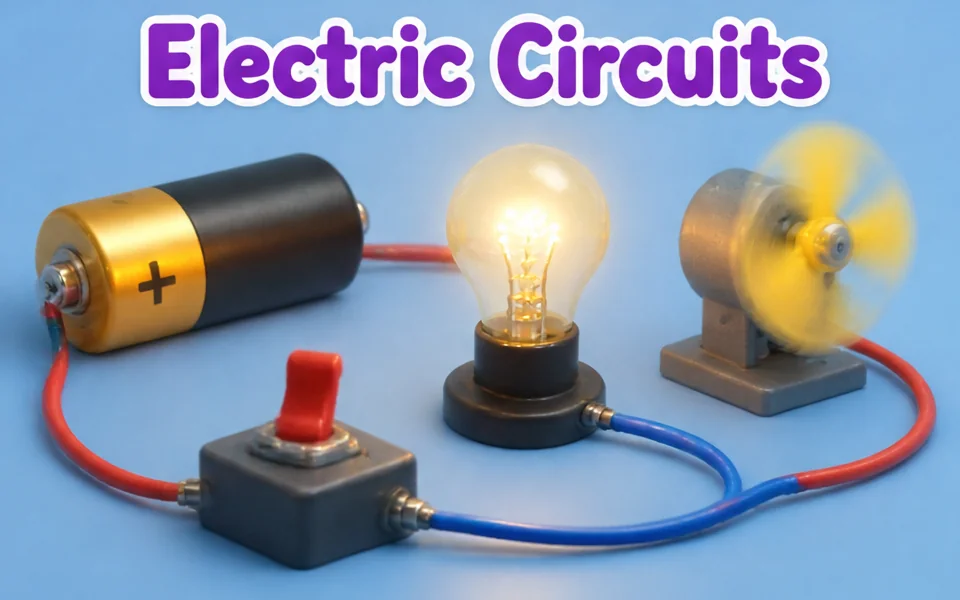 SimulaçãoSimulação interativa de Circuitos elétricos
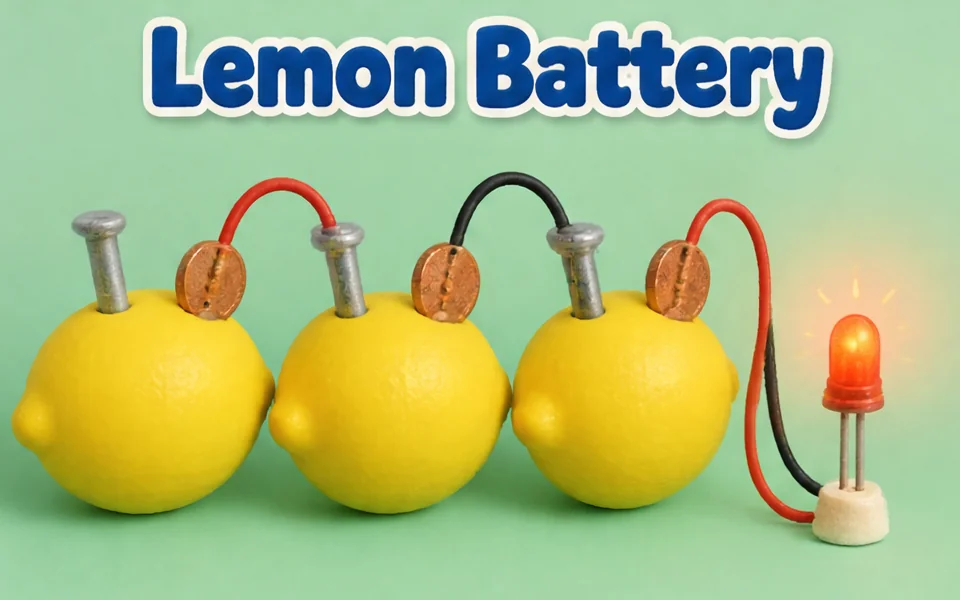 SimulaçãoLemon Battery
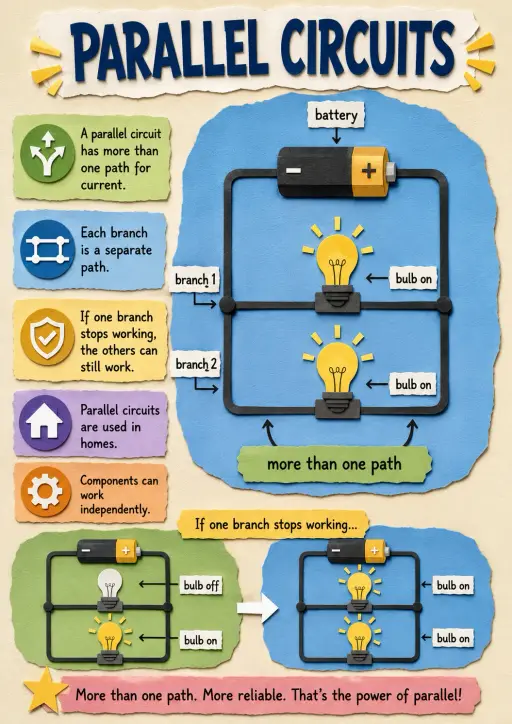 AtividadeParallel Circuits Electricity and Magnetism Infographic
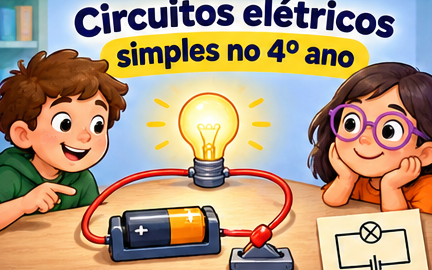 JogoCircuitos elétricos simples no 4º ano
Sobre esta simulação
Students drag parts into slot 1, which is in series with the battery, and slots 2 and 3, which are two parallel branches. They click the switch to open or close the circuit and use a slider to set the battery between 1.5 and 12 volts. Readouts show battery voltage, total current, total power and total resistance, and bulbs glow according to their power. An empty slot is a gap, and above about 7.2 V a 4.5 V bulb burns out. Teachers can compare series and parallel brightness and apply V = I x R.
O que os alunos podem explorar
- Place one bulb in slot 1 and close the switch, then read Total current I and Total resistance.
- Add a second bulb in series and notice how both bulbs dim as the resistance grows.
- Fill the two parallel slots with bulbs and compare their brightness with the series version.
- Leave one slot empty to see a gap stop the current, or fill it with a wire piece.
- Raise the Battery slider past about 7 V to burn a bulb, then press Replace burnt bulbs.
Objetivos de aprendizagem
- 1Compare current and brightness in series and parallel arrangements.
- 2Apply V = I x R and P = V x I to readings from the circuit.
- 3Explain why adding bulbs in series raises total resistance.
- 4Describe how excess voltage damages a bulb filament.
Perguntas frequentes dos professores
Is it free to use?
Yes. It is completely free, needs no sign-up, and runs in any modern browser, including classroom whiteboards, tablets and phones. Just open the page and start.
Why are bulbs dimmer in series?
In series the battery voltage is shared between the bulbs and the total resistance is higher, so less current flows through all of them. In parallel each branch gets the full voltage.
How do I build the circuit?
Drag a bulb or wire piece into one of the three slots, click the switch to close the circuit, and move the Battery slider to change the voltage. Watch the readouts for current and power.
What does an empty slot do?
An empty series slot is a gap, so no current flows at all. An empty parallel slot just removes that branch, while the other branch keeps working. A wire piece fills a slot with almost no resistance.
Incorporar esta simulação
Coloque no seu AVA, blog ou site da turma — de graça.
<iframe src="https://kiwibee.io/pt/simulations/circuit-builder-bulbs-3d-simulation/embed" title="Circuit Builder | KiwiBee" loading="lazy" allowfullscreen style="width:100%;height:min(70vh,620px);min-height:420px;border:0;border-radius:16px"></iframe>Padrões curriculares
Cambridge
- 9Pe.01Describe how current divides in parallel circuits.Cambridge Lower Secondary Science (0893) — Stage 9 › Physics › Electricity and magnetism
- 9Pe.02Know how to measure current and voltage in series and parallel circuits, and describe the effect of adding cells and lamps.Cambridge Lower Secondary Science (0893) — Stage 9 › Physics › Electricity and magnetism
Learning objectives © UCLES (Cambridge University Press & Assessment), quoted with attribution.
Leve a ciência interativa para a sua sala de aula
O espaço gratuito do professor da KiwiBee reúne em um só lugar o planejamento de aulas, as atividades, as ferramentas de sala e o diário de classe.
Comece grátis e crie sua primeira turmaAssista ao KiwiBee no YouTube
Vídeos curtos do KiwiBee para professores e escolas. Inscreva-se ou siga o KiwiBee onde você estiver.
 Início
 Todas as soluções
 Preços
 Sobre nós
 KiwiBee para organizações sem fins lucrativos
 Eventos e webinars
 Para grandes redes de ensino
 Para escolas
 Para centros educacionais
 Para líderes de equipe
 Para professores
 Recursos
 Atividades para imprimir
 Simulações interativas
 Ferramentas para professores
 Ideias e pesquisa


