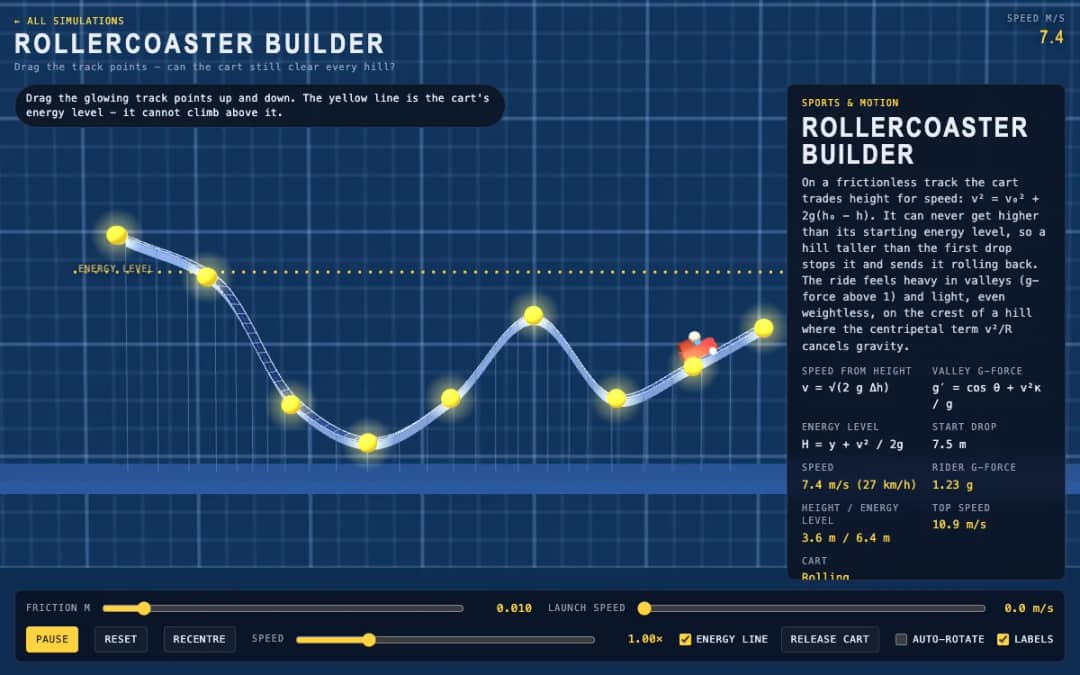
A smooth coaster track runs through glowing control points. Students drag points up and down to reshape hills, press Release cart, and see whether the cart can clear every hill below the yellow energy line.
—
KiwiBee menggunakan cookie opsional dari Google Analytics, Google Ads, dan Meta Pixel untuk memahami pengunjung dewasa, mengukur pendaftaran yang selesai, dan meningkatkan kampanye. Cookie penting selalu aktif. Pixel iklan ChatGPT OpenAI juga mengukur tampilan halaman dan pertanyaan yang telah dikirim setelah persetujuan iklan, serta dapat menggunakan detail kontak yang di-hash untuk pencocokan. Kebijakan privasi
This simulation models the mat as a spring with damping. The jumper stores energy in the stretched mat and gets it back as speed, but real mats lose some energy, so each peak is lower by the factor e squared, where e is the restitution. Students drag the jumper to set a drop height and read drop height, last peak, first peak ratio, mat depth and force over weight. Sliders set restitution, mat stiffness, mass and gravity, so students can bounce on the Moon. Teachers can use it for springs and energy loss.
Yes. It is free, needs no sign-up, and runs in any modern browser, including whiteboards, tablets and phones.
The mat and jumper lose some energy as heat. With coefficient of restitution e, each peak is lower than the previous one by a factor of e squared.
Drag the jumper up and let go, or push them down into the mat and release. The Last peak marker shows the height reached after each bounce.
It pushes back with force F equals k times the depth x. A stiffer mat has a larger k, so it compresses less under the same load and the rest sag is mass times g over k.
Pasang di LMS, blog, atau situs kelas Anda — gratis.
<iframe src="https://kiwibee.io/id/simulations/trampoline-bounce-3d-simulation/embed" title="Trampoline Bounce | KiwiBee" loading="lazy" allowfullscreen style="width:100%;height:min(70vh,620px);min-height:420px;border:0;border-radius:16px"></iframe>Lanjut menjelajah
A smooth coaster track runs through glowing control points. Students drag points up and down to reshape hills, press Release cart, and see whether the cart can clear every hill below the yellow energy line.
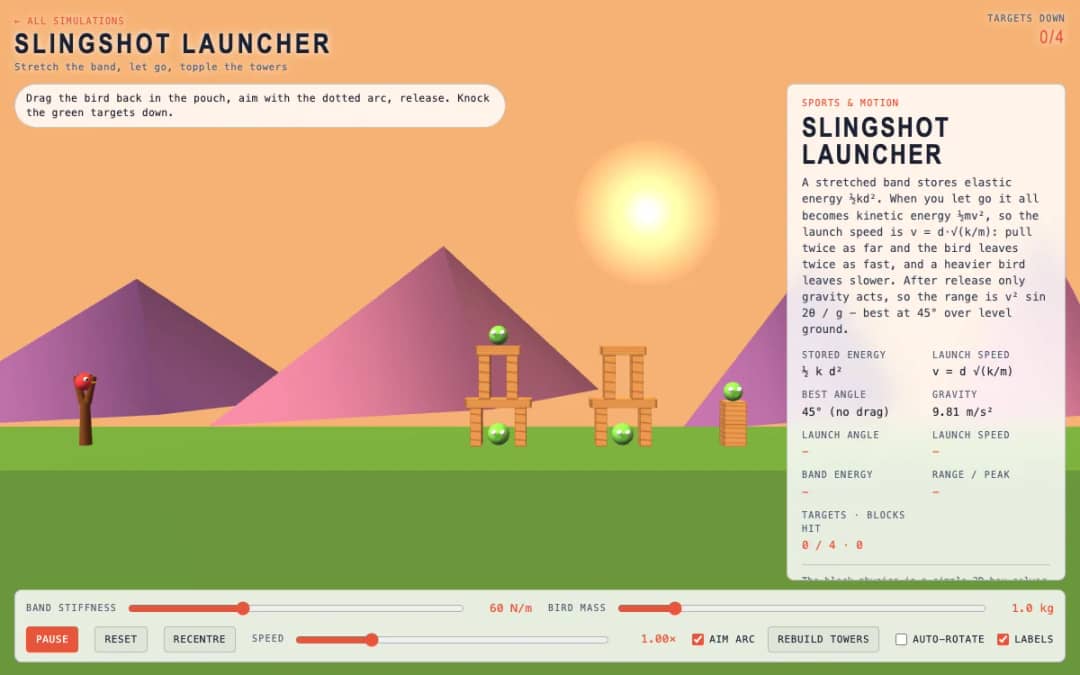
A slingshot faces towers with green targets. Students drag the bird back in the pouch, follow the dotted aim arc, release, and try to knock down the targets using the right stretch and angle.
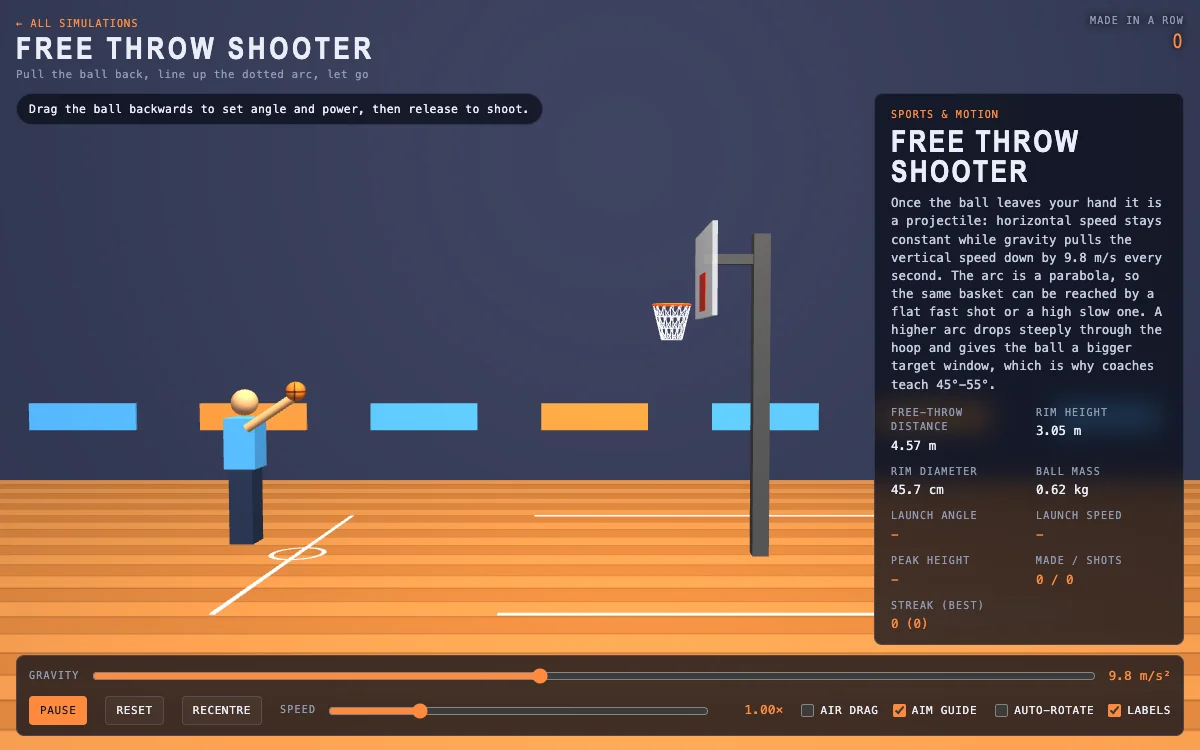
A basketball court shows the free throw line, hoop and a dotted aim arc. Students drag the ball backward to set launch angle and power, release to shoot, and read speed, peak height and streak.
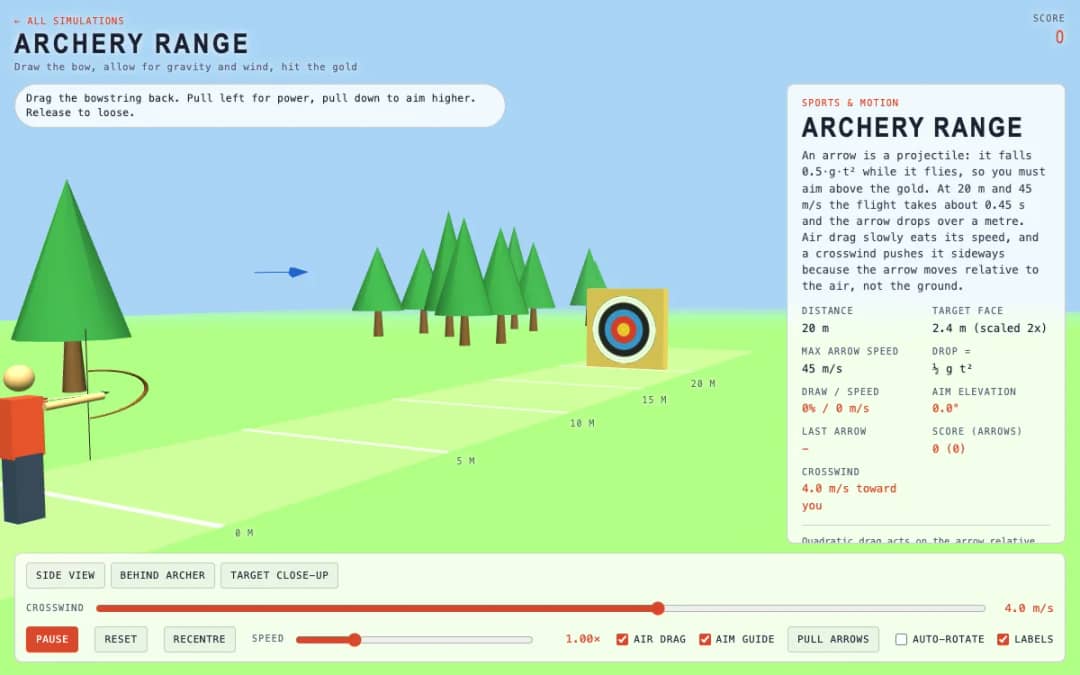
An archery range with a target 20 meters away lets students drag the bowstring back to set power and aim, then loose six arrows while allowing for gravity, drag and a crosswind.
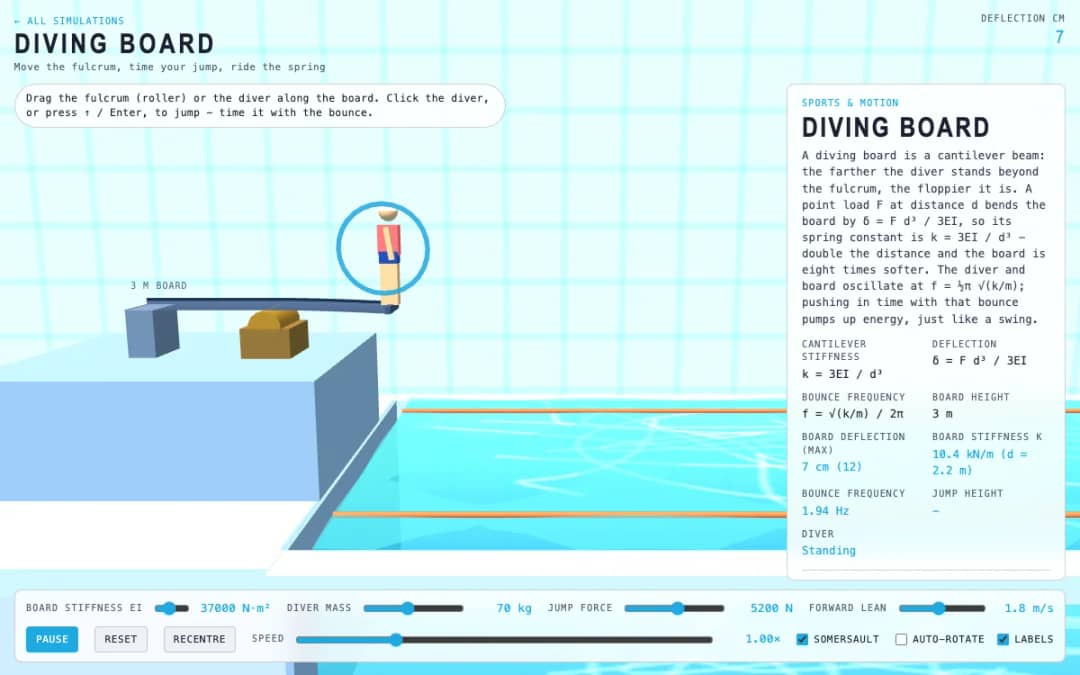
A diving board hangs over a pool at three meters. Students drag the fulcrum roller or the diver along the board, click the diver or press Enter to jump, and time pushes with the board's bounce.
Ruang kerja guru gratis dari KiwiBee menyatukan perencanaan pembelajaran, lembar kerja, perangkat kelas, dan buku nilai dalam satu tempat.
Mulai gratis dan buat kelas pertama Anda Beranda
 Semua solusi
 Harga
 Tentang kami
 KiwiBee untuk Organisasi Nirlaba
 Acara & webinar
 Untuk organisasi besar
 Untuk sekolah
 Untuk lembaga kursus
 Untuk ketua tim
 Untuk guru
 AI dan sumber belajar
 Sumber belajar
 Lembar kerja siap cetak
 Paket Pelajaran
 Simulasi interaktif
 Alat untuk guru
 Studio AI
 Ide dan riset