
Explore an adult male reference body in 3D. Reveal 14 anatomical systems, search thousands of named structures, isolate organs, and pull 2,209 modeled pieces apart to see how the body is organized.
—
KiwiBee usa cookies opcionales de Google Analytics, Google Ads y Meta Pixel para entender a los visitantes adultos, medir los registros completados y mejorar las campañas. Las cookies esenciales siempre permanecen activas. El píxel de anuncios de ChatGPT de OpenAI también mide las visitas y las consultas enviadas tras aceptar la publicidad, y puede usar datos de contacto cifrados mediante hash para la atribución. Política de privacidad
Reflex Arc follows a nerve signal from receptor to muscle. Students click the reflex hammer to tap the knee or touch the hot plate, then watch the impulse run along a sensory neuron, cross a synapse in the spinal cord and return along a motor neuron to the muscle. Readouts give the time for each step, the total reflex time and when the brain finds out. Sliders set slow motion, nerve myelin health and tap strength, so students can see how damage slows the response. It shows why reflexes are faster than thinking.
Yes. Students can use it without creating an account, on any modern browser and on whiteboards, tablets or phones.
The signal goes through the spinal cord and does not wait for the brain to decide. Fewer synapses and a short path mean a knee jerk takes about 25 ms while a voluntary reaction takes about 200 ms.
Yes. The milliseconds shown are calculated from nerve distance and speed plus synapse and muscle delays. Only the animation is slowed down, using the Slow motion slider.
Click the reflex hammer, or press Tap knee, to test the knee-jerk reflex. Click the hot plate, or press Touch hot plate, to start the withdrawal reflex.
Colócala en tu LMS, blog o sitio de clase, gratis.
<iframe src="https://kiwibee.io/es/simulations/reflex-arc-3d-simulation/embed" title="Reflex Arc | KiwiBee" loading="lazy" allowfullscreen style="width:100%;height:min(70vh,620px);min-height:420px;border:0;border-radius:16px"></iframe>Sigue explorando
Explore an adult male reference body in 3D. Reveal 14 anatomical systems, search thousands of named structures, isolate organs, and pull 2,209 modeled pieces apart to see how the body is organized.
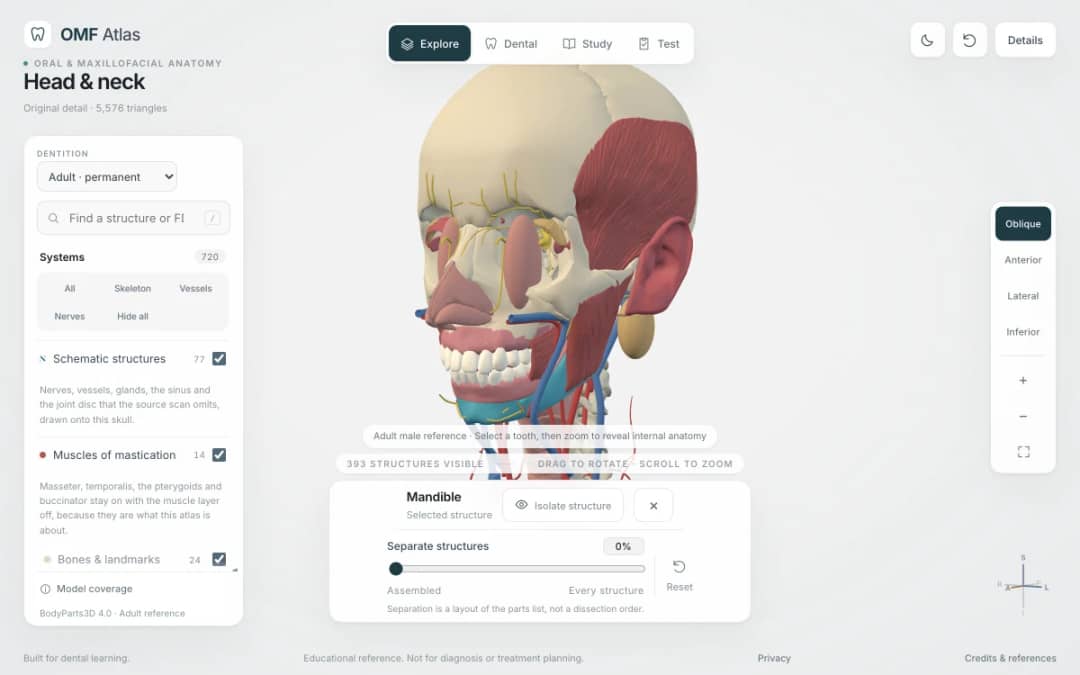
Explore the head and neck in 3D: 643 source meshes across 14 layers, 47 facial and masticatory muscles, and 77 drawn nerves, vessels and glands the source scan omits. Open any tooth onto its own pulp canal, and follow the seven stages of tooth development.

Free interactive photosynthesis simulation. Explore photosynthesis hands-on online — great for whole-class or independent practice.

Free interactive states of matter simulation. Explore states of matter hands-on online — great for whole-class or independent practice.

Free interactive shadows simulation. Explore shadows hands-on online — great for whole-class or independent practice.
El espacio de trabajo gratuito para docentes de KiwiBee reúne en un solo lugar la planificación de clases, las fichas, las herramientas de aula y el libro de calificaciones.
Empieza gratis y crea tu primera clase Inicio
 Todas las soluciones
 Precios
 Quiénes somos
 KiwiBee para organizaciones sin fines de lucro
 Eventos y seminarios web
 Para grandes organizaciones
 Para escuelas
 Para centros de aprendizaje
 Para líderes de equipo
 Para docentes
 IA y recursos
 Recursos
 Hojas de trabajo imprimibles
 Paquetes didácticos
 Simulaciones interactivas
 Herramientas para docentes
 Estudio de IA
 Ideas e investigación