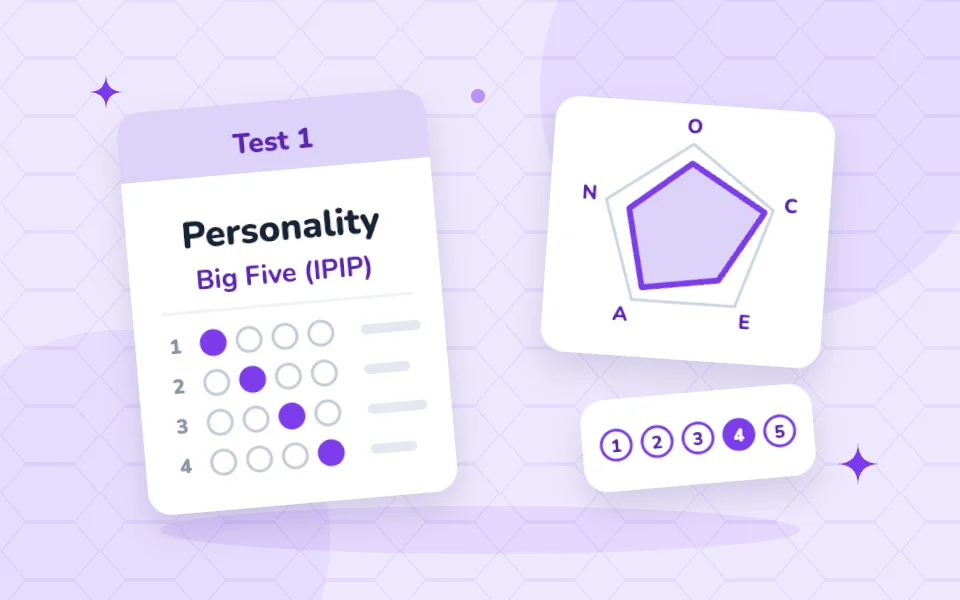
 Big Five Classroom Personality Inventory (Mini-IPIP · 20 Items)PersonalityBig Five (IPIP)
——
O KiwiBee usa cookies opcionais do Google Analytics, Google Ads e Meta Pixel para entender os visitantes adultos, medir cadastros concluídos e melhorar as campanhas. Os cookies essenciais ficam sempre ativos. O Pixel de anúncios do ChatGPT da OpenAI também mede visitas e consultas enviadas após o consentimento publicitário e pode usar dados de contato com hash para correspondência. Política de privacidade

Public-domain Big Five (OCEAN) classroom personality inventories with clean 1-to-5 Likert rating grids, self-scoring tables, writing & speaking reflection prompts and teacher reverse-scoring keys.
Open any paper to inspect every page and customise it in the KiwiBee Worksheet Print Studio.
KiwiBee's classroom personality inventories draw strictly on public-domain International Personality Item Pool (IPIP) items originated by Lewis Goldberg and the Mini-IPIP short form (Donnellan et al., 2006). They support student self-awareness, balanced group formation and classroom research — not psychological labelling or clinical diagnosis.
Unlike commercial typology quizzes that sort students into fixed boxes, the Big Five measures five continuous, research-backed dimensions that help students reflect on how they work and collaborate.
Curiosity for new ideas, abstract concepts and creative problem-solving — useful when planning inquiry projects and open-ended assignments.
Organisation, follow-through and planning habits — helps teachers pair structure-loving planners with spontaneous brainstormers during team tasks.
Energy in group discussions versus quiet reflection — guides fair classroom participation norms so both outspoken and reflective voices thrive.
Empathy, cooperative warmth and calm under academic pressure — supports social-emotional learning (SEL) and supportive peer feedback routines.
Every paper uses the same KiwiBee Worksheet Print & Edit Studio used across worksheets, exams and olympiads.
Explore KiwiBee's connected assessment libraries for teachers and schools.
The Big Five is the gold standard in peer-reviewed personality psychology, has strong reliability across cultures and ages, and the International Personality Item Pool (IPIP) is explicitly in the public domain — so schools can print, translate and co-brand it legally.
Negatively worded statements (marked R in the teacher key) flip on the 1-to-5 scale (1 becomes 5, 2 becomes 4, 3 stays 3, 4 becomes 2, 5 becomes 1) to reduce acquiescence bias. The teacher answer booklet prints the exact scoring map.
The 20-item Mini-IPIP works best with upper-primary through high-school learners (roughly ages 11 to 18) and takes about 10 minutes to complete plus 10–15 minutes for writing and speaking reflection.
Never. There are no 'good' or 'bad' personality profiles. Keep individual responses private to the student (and teacher/counselor with consent) and only share anonymised class-level summaries during research discussions.
 Início
 Todas as soluções
 Preços
 Sobre nós
 KiwiBee para organizações sem fins lucrativos
 Eventos e webinars
 Para grandes redes de ensino
 Para escolas
 Para centros educacionais
 Para líderes de equipe
 Para professores
 Recursos
 Atividades para imprimir
 Simulações interativas
 Ferramentas para professores
 Ideias e pesquisa