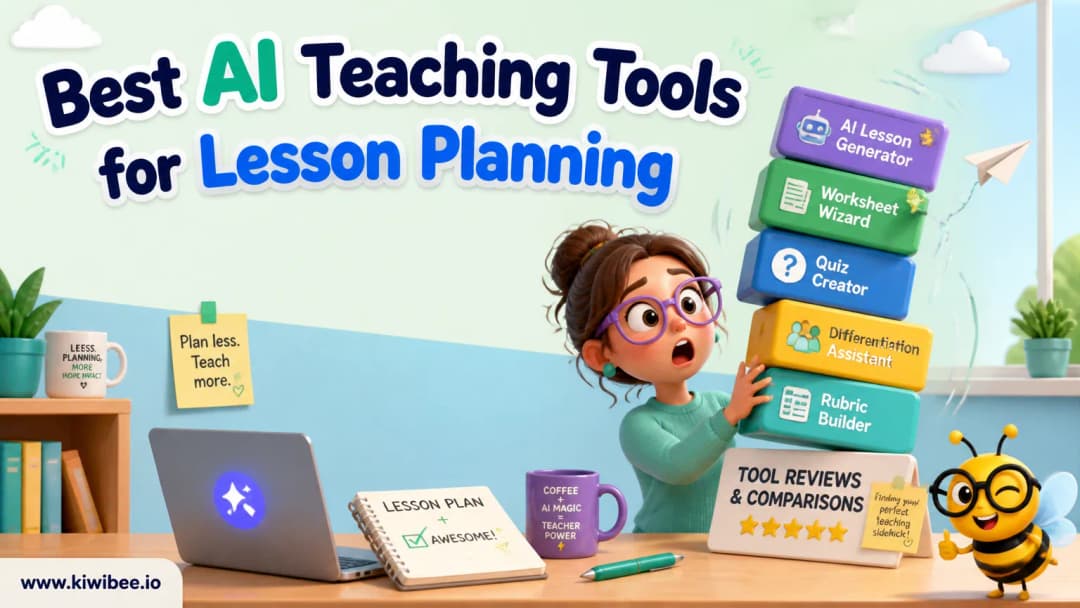
Best AI Teaching Tools for Lesson Planning in 2026
From KiwiBee TeacherLab to MagicSchool — we tested the best AI teaching tools on real lesson plans and scored them head-to-head.
 By KiwiBee· KiwiBee
Last updated June 1, 2026
Why AI Teaching Tools Have Become Table Stakes
Two years after ChatGPT entered every staff room, AI teaching tools have moved from novelty to necessity. Teachers use them to draft lesson objectives, generate reading passages at three levels, write rubrics, respond to parent emails, and pull together report-card comments at the end of term. The problem isn't whether AI helps — it clearly does. The problem is that most of the popular options are standalone generators that live in their own browser tab and have no idea which students are in your class, what they scored on yesterday's quiz, or what unit you're actually teaching. For 2026 we benchmarked the five most-talked-about AI teaching tools on a real Grade 6 science unit and a high school English writing unit to see which ones save time and which ones just generate filler.
How We Ranked These Tools
Our rubric had five weighted criteria: 1) quality of generated lesson plans and worksheets against a veteran-teacher reference, 2) integration with gradebook and student-data context, 3) differentiation support (IEP, ELL, reading level), 4) time saved end-to-end from idea to printable materials, and 5) pricing at the per-teacher and whole-school scale. We deliberately weighted integration and differentiation highly because those are the two areas where generic ChatGPT usage falls apart for real classrooms.
1. KiwiBee TeacherLab — AI That Knows Your Class
KiwiBee TeacherLab wins because it's the only tool on this list where AI has native access to your actual class context. Our AI lesson planner knows which standards your curriculum module is targeting, who scored below 70% on the last quiz, and which students have an IEP. That means a request like 'generate a 45-minute photosynthesis lesson with a tier-2 worksheet for my five ELL students' produces materials that are genuinely aligned to your class, not a generic template you then have to customize for twenty minutes.
Integration keeps paying dividends downstream. Generated assignments drop straight into the homework and assignment module with rubrics attached, and scored work flows back into the Skills Gradebook automatically. When it's time to write report-card comments, TeacherLab drafts them from real performance data, not a blank prompt. Teachers in our pilot estimated they saved 4-7 hours per week, with the biggest gains coming from end-of-term report writing and parent-email drafting.
TeacherLab ships inside the broader KiwiBee platform and is included in our main plans rather than sold as a separate subscription. If you're already using KiwiBee for gradebook, behavior, or scheduling, TeacherLab unlocks without an extra invoice. Individual teachers can explore it on the free teacher plan before a school-wide rollout.
2. MagicSchool.ai — The Popular Standalone Generator
MagicSchool has done the best job of any vendor at making AI feel approachable for teachers, with more than 80 prewritten 'tools' ranging from lesson planners to IEP drafters to parent-email writers. The UX is warm, the marketing is polished, and the generated outputs are solid for a generic request. It's an easy yes for an individual teacher who wants AI help without learning prompts. The honest limitation is that MagicSchool is a standalone generator — it has no idea who your students are, what they scored on last week's test, or which standard you're teaching. Every request starts from scratch, and outputs go into Google Docs or Word, not into your gradebook. For a single teacher that's fine; for a school trying to reduce apps, it's one more subscription sitting beside your existing stack.
3. Eduaide.ai — Lightweight and Fast
Eduaide is a snappier, more utilitarian alternative to MagicSchool with a strong focus on lesson objectives, quick worksheets, and rubric scaffolding. Teachers who want an AI copilot that gets out of the way tend to like it, and the output quality on short generation tasks is genuinely competitive with the bigger names. Pricing is teacher-friendly and there's a useful free tier. The same structural limitation applies, though: Eduaide is a generator without context, so anything beyond a one-off worksheet requires copy-paste back into your real systems. It's a great add-on for a teacher who already has a gradebook and LMS they like, and a poor fit if the goal is reducing the overall tool count.
4. Diffit — The Differentiation Specialist
Diffit does one thing and does it very well: take any topic, article, or YouTube video and generate reading passages plus comprehension questions at multiple reading levels, with vocabulary supports and summaries. For ELL teachers and special educators it's quietly one of the most useful AI tools in the category, and we'd happily recommend it inside a broader workflow. The caveat is that it's intentionally narrow — Diffit isn't trying to plan your full lesson, write your rubric, or generate report comments. If differentiation is your bottleneck, it's worth using; if you want a single AI tool that covers planning, grading, and communication, it's too specialized on its own.
5. Curipod — AI for Interactive Lesson Delivery
Curipod occupies an interesting niche: it uses AI to generate interactive lesson slides with embedded polls, open questions, word clouds, and drawings — think Nearpod meets ChatGPT. For teachers who live in front of a projector and want high-engagement lesson delivery, Curipod is genuinely clever and the student-response features drive real participation. The limit is scope: Curipod is a presentation tool, not a planning or grading system. Teachers still need a separate lesson planner, a separate gradebook, and a separate way to track which students struggled on which slide across time. It's a useful complement to a broader platform, but it won't replace your planning workflow.
Which Should You Pick?
If you're an individual teacher who just wants an approachable AI sidekick, MagicSchool or Eduaide will improve your week immediately. If your pain point is reading differentiation, Diffit is worth every penny. If your classroom lives on the projector, Curipod will make your lessons more interactive. But if you want AI that actually knows your students, writes your report cards from real data, and drops lesson plans straight into your gradebook, KiwiBee TeacherLab is the only tool on this list built for that — because it ships inside a full platform rather than in a standalone tab. Explore the full stack on our teacher plans page and see what AI looks like when it has context.
Explore the platform
Continue with KiwiBee
Choose the KiwiBee workspace or resource library that fits what you need next.
Get one practical teaching resource in your inbox each week.
Related posts
Best AI Grading Tools for Teachers in 2026
Best AI Grading Tools for Teachers in 2026. An honest review of the leading classroom tools with strengths, weaknesses, and how to pick the right one for your context.
Best Classroom Management Platforms in 2026
A hands-on ranking of the best classroom management platform options in 2026, comparing KiwiBee, ClassDojo, Bloomz, LiveSchool, and Class123 on integration, AI, and price.
 Home
Home All solutions
 Pricing
 About us
 KiwiBee for Non-profits
 Events & webinars
 For big organisations
 For schools
 For centers
 For team leaders
 For teachers
 AI and resources
 Resources
 Printable worksheets
 Lesson Packs
 Interactive simulations
 Teacher tools
 AI studio
 Ideas and research