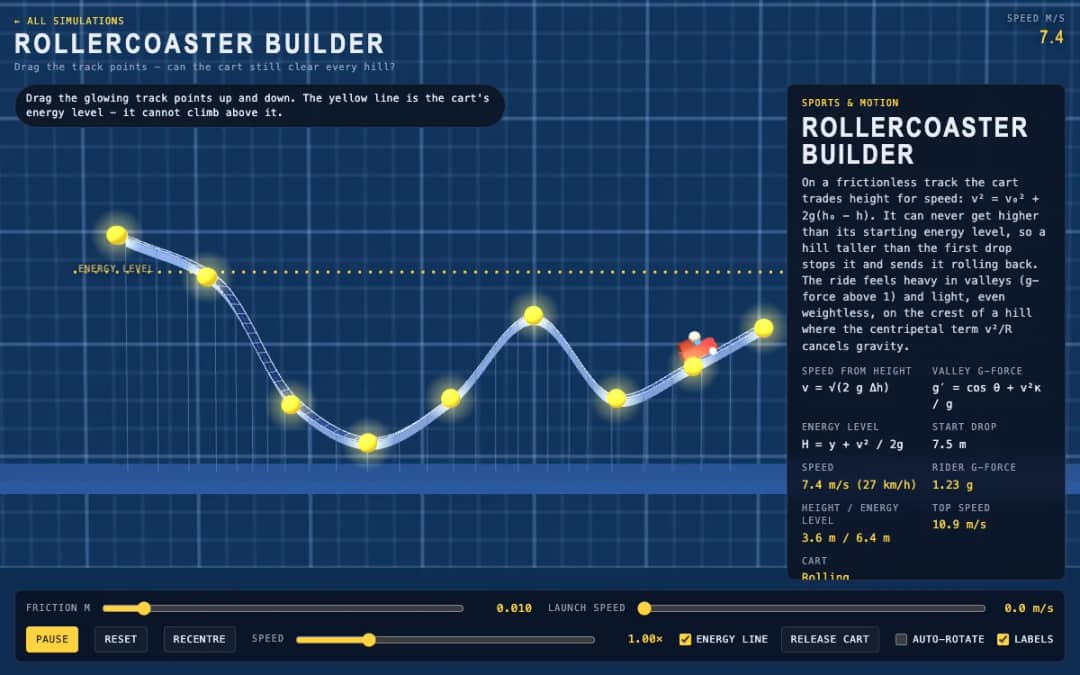
A smooth coaster track runs through glowing control points. Students drag points up and down to reshape hills, press Release cart, and see whether the cart can clear every hill below the yellow energy line.
—
يستخدم KiwiBee ملفات تعريف ارتباط اختيارية من Google Analytics وGoogle Ads وMeta Pixel لفهم الزوار البالغين، وقياس عمليات التسجيل المكتملة، وتحسين الحملات. تبقى ملفات تعريف الارتباط الأساسية مفعّلة دائمًا. يقيس بكسل إعلانات ChatGPT من OpenAI أيضًا مشاهدات الصفحات والاستفسارات المرسلة بعد الموافقة على الإعلانات، وقد يستخدم بيانات اتصال مجزأة للمطابقة. سياسة الخصوصية
This simulation models the mat as a spring with damping. The jumper stores energy in the stretched mat and gets it back as speed, but real mats lose some energy, so each peak is lower by the factor e squared, where e is the restitution. Students drag the jumper to set a drop height and read drop height, last peak, first peak ratio, mat depth and force over weight. Sliders set restitution, mat stiffness, mass and gravity, so students can bounce on the Moon. Teachers can use it for springs and energy loss.
Yes. It is free, needs no sign-up, and runs in any modern browser, including whiteboards, tablets and phones.
The mat and jumper lose some energy as heat. With coefficient of restitution e, each peak is lower than the previous one by a factor of e squared.
Drag the jumper up and let go, or push them down into the mat and release. The Last peak marker shows the height reached after each bounce.
It pushes back with force F equals k times the depth x. A stiffer mat has a larger k, so it compresses less under the same load and the rest sag is mass times g over k.
ضعها في منصتك التعليمية أو مدونتك أو موقع صفك — مجانًا.
<iframe src="https://kiwibee.io/ar/simulations/trampoline-bounce-3d-simulation/embed" title="Trampoline Bounce | KiwiBee" loading="lazy" allowfullscreen style="width:100%;height:min(70vh,620px);min-height:420px;border:0;border-radius:16px"></iframe>واصل الاستكشاف
A smooth coaster track runs through glowing control points. Students drag points up and down to reshape hills, press Release cart, and see whether the cart can clear every hill below the yellow energy line.
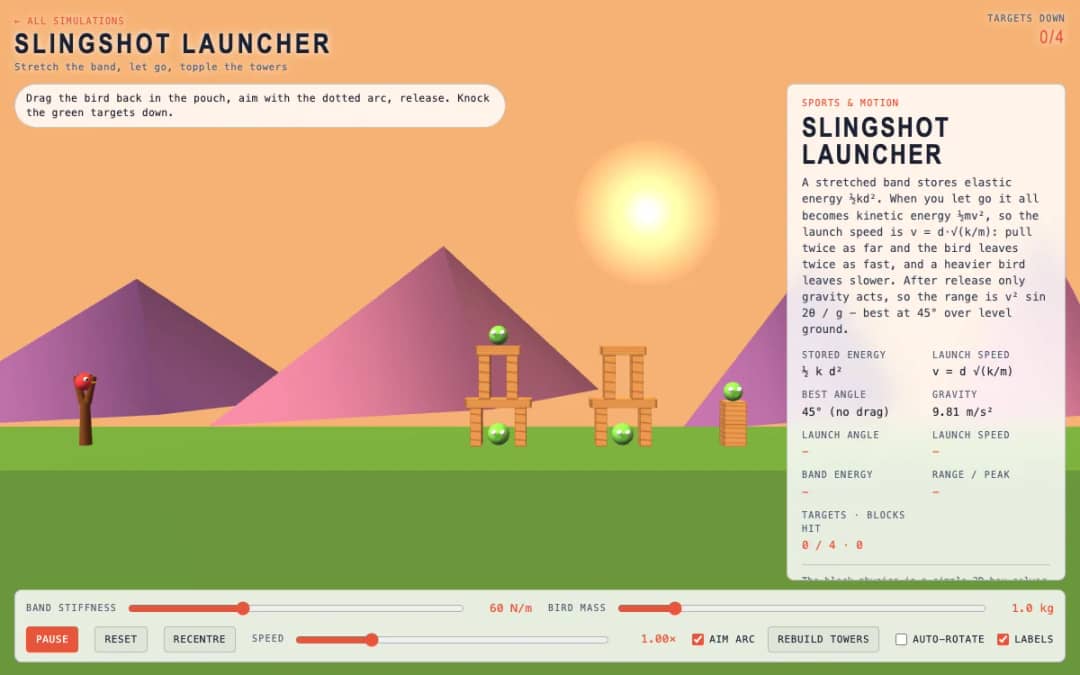
A slingshot faces towers with green targets. Students drag the bird back in the pouch, follow the dotted aim arc, release, and try to knock down the targets using the right stretch and angle.
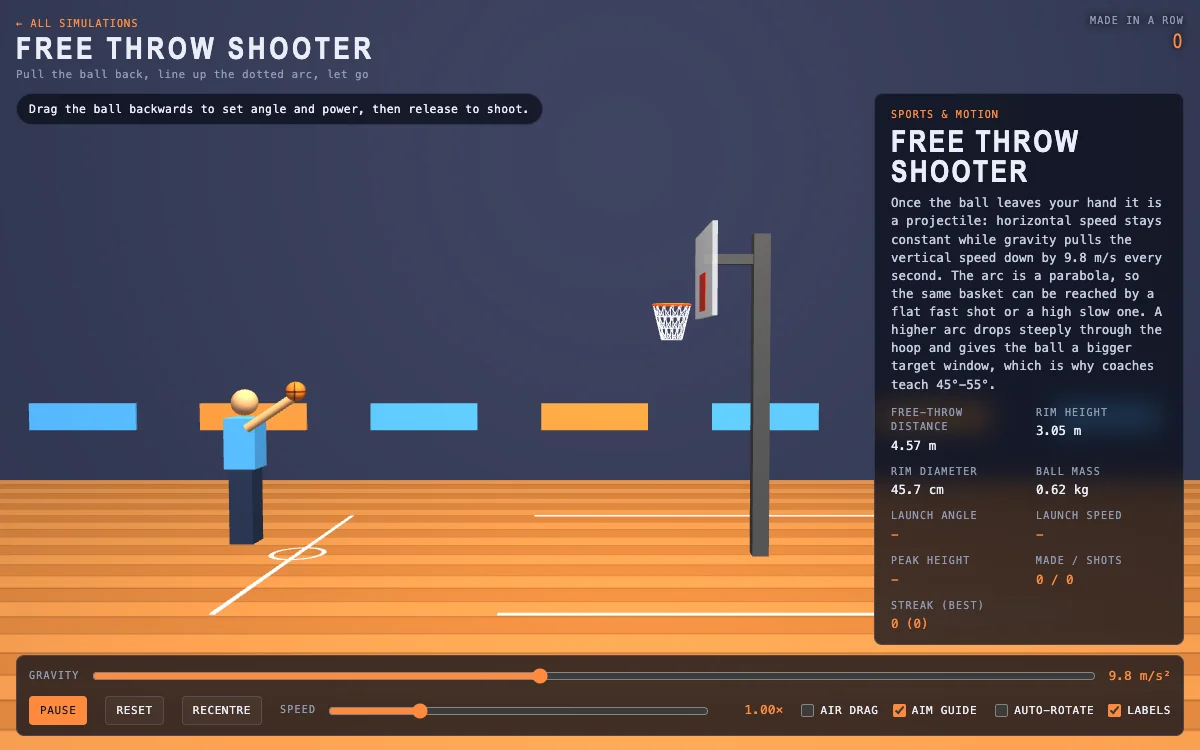
A basketball court shows the free throw line, hoop and a dotted aim arc. Students drag the ball backward to set launch angle and power, release to shoot, and read speed, peak height and streak.
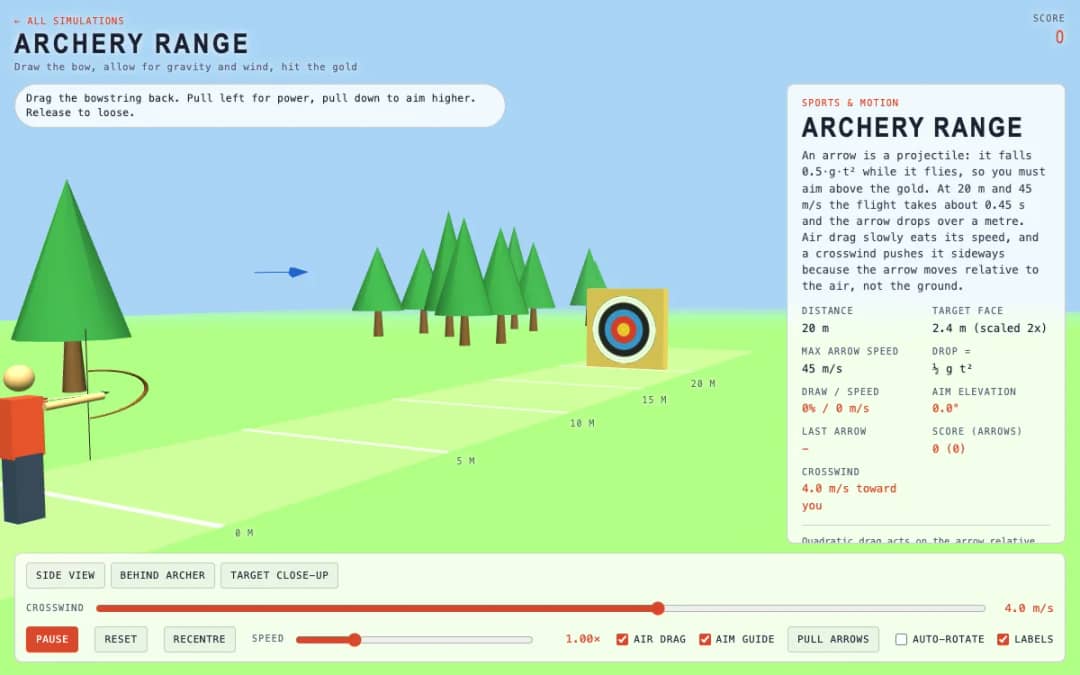
An archery range with a target 20 meters away lets students drag the bowstring back to set power and aim, then loose six arrows while allowing for gravity, drag and a crosswind.
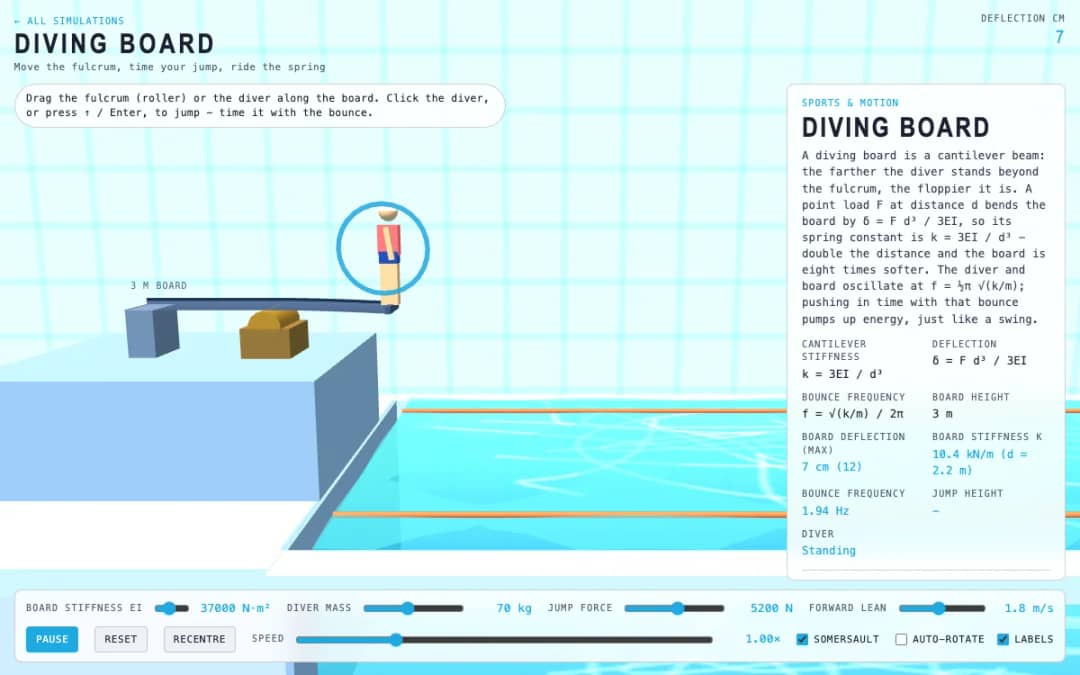
A diving board hangs over a pool at three meters. Students drag the fulcrum roller or the diver along the board, click the diver or press Enter to jump, and time pushes with the board's bounce.
مساحة المعلم المجانية في KiwiBee تجمع تخطيط الدروس وأوراق العمل وأدوات الصف وسجل الدرجات في مكان واحد.
ابدأ مجانًا وأنشئ صفك الأول الرئيسية
 كل الحلول
 الأسعار
 من نحن
 برنامج KiwiBee للمنظمات غير الربحية
 الفعاليات والندوات
 للمؤسسات الكبيرة
 للمدارس
 للمراكز التعليمية
 لقادة الفرق
 للمعلمين
 الذكاء الاصطناعي والموارد
 الموارد
 أوراق عمل قابلة للطباعة
 حزم الدروس
 محاكاة تفاعلية
 أدوات المعلم
 استوديو الذكاء الاصطناعي
 أفكار وأبحاث